Big Damn Heroes? Shiny!!! – Firefly Attempting Animated Reboot
 Firefly
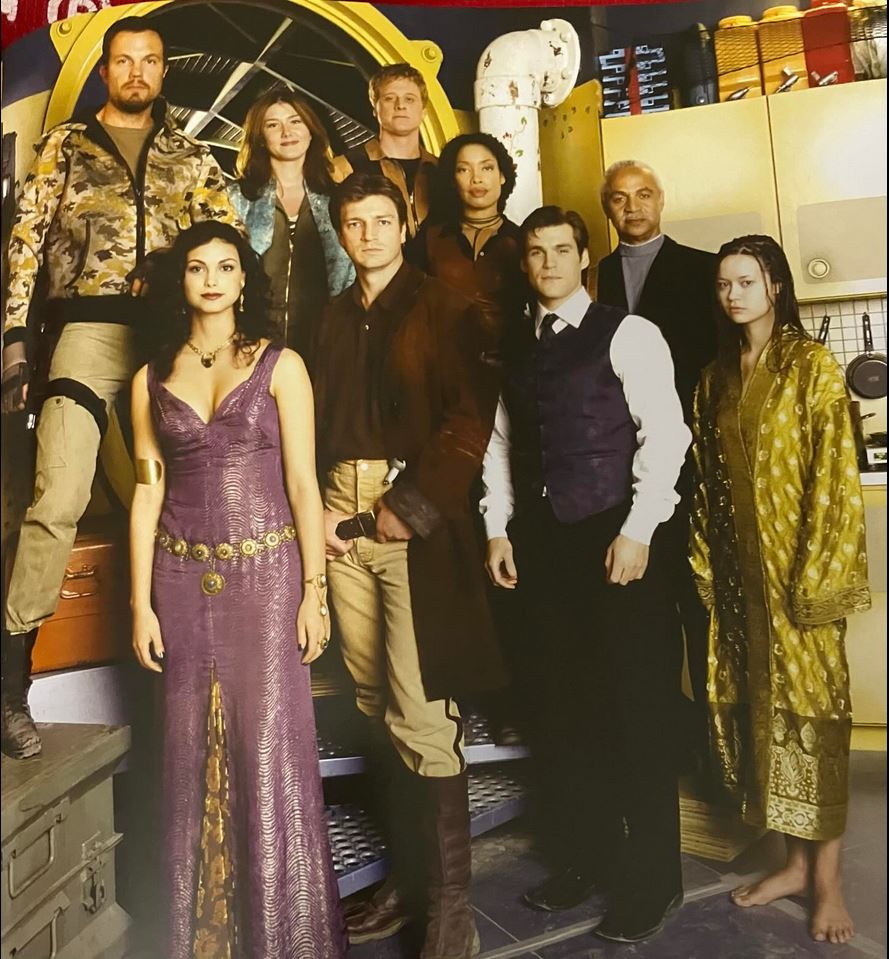
For a show that hardly anybody watched (it was reportedly 98th in the Nielsen Ratings for 2002-2003. The TV Guide Ratings page has it at 125th, and Fox’s lowest-ranked show), that one word carries a lot of weight 23 years later.
Fox famously aired the double-length pilot, which set the show up, as episode eleven, and then canceled the show, leaving three episodes unaired. It was also placed in the legendary Friday Night Death slot (where they also buried the far-more deserving The Adventures of Brisco County Jr).
The crew got to reunite and wrap things up two years later in the movie Serenity (which killed off two cast members). There were hopes to do more movies, but even after cutting the budget from $100 million to $39 million, it lost money in the US (98th) and barely broke even worldwide (111th). And the Serenity (which is the ship: Firefly is its class) was grounded for good.
But over the years, Firefly came to be the definitive ‘cult classic,’ and the cast became fan convention staples. You can find all kinds of Firefly info on the web. And both streaming on Hulu, and Prime, the episodes are in order, which I HIGHLY recommend for viewing. Novels, board games, graphic novels — interest remained alive in more Firefly ‘stuff.’
I mentioned that Nathan Fillion and Alan Tudyk started a weekly podcast (Once We Were Spacemen), which is geek heaven. They’ve had several Firefly members on, and other folks from their careers. I love it.
THE BUILDUP
On February 23, a story/vid dropped on their IG page. Nathan Fillion knocks on the door of what looks like Gina Torres’ (Zoe) on-set trailer. She asks “Does this mean it’s time.” He replies, “It’s time.” She looks up wistfully, and Fillion looks confusedly at the skies, as if for Serenity. They both say ‘okay’ a few times and it ends. My response was “Holy crap! What’s happening?”
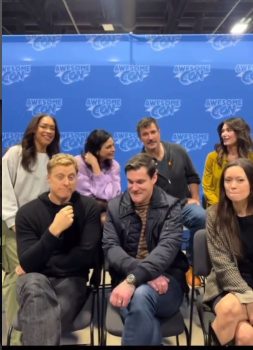
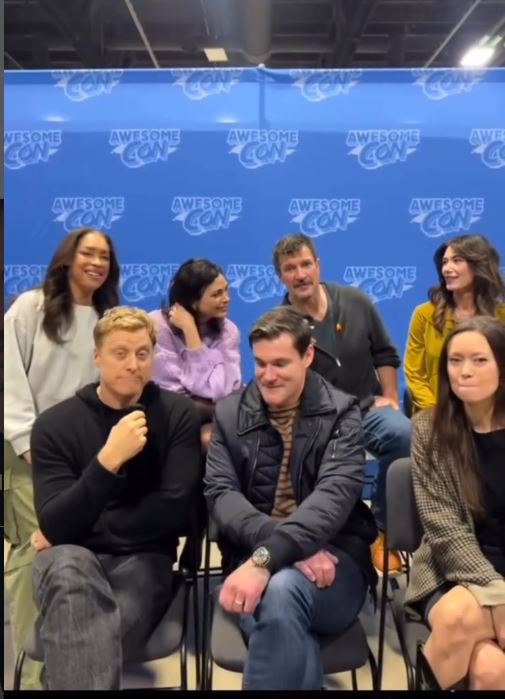
The Firefly fandom lost its collective mind and speculation was immediate. While a full-blown revival has been a dream for two decades, common thoughts were a gathering at a convention, or a reunion on Fillion’s show The Rookie, or on a podcast.
Two days later, Fillion shows up at Morena Baccarin’s (Inara) house. She is currently starring in the Fire Country spin-off, Sheriff Country. This one is cute, as Fillion is in his The Rookie uniform. And she answers in her sheriff uniform. He flashes that boyish smile and starts to comment they’re both in their uniforms, and she cuts him off with “You son of a bitch.” “He’s startled. “Are we doing this?” “Oh. We’re doing this.” More gravely serious head nodding.
Firefly fans were abuzz after the Gina vid. Now, with two, clearly something was going on. And the stakes has been raised.
 There is a new line of Firefly Funko Pops coming out, and the cynical dismissed this new ‘thing’ as leading to pushing the Funkos. While that’s certainly not beyond the realm of possibility, Fillion had to know that would be an incredibly disappointing payoff after generating so much excitement.
Two days after that (now it’s February 27), Fillion knocks on Sean Maher’s (Simon) door. Maher peaks through, opens the door, says “We don’t want any,” then shuts it and goes back inside. Filion makes a despairing face, knocks again, points at his face with a “It’s Nathan” expression as Maher opens the door. The ‘It’s happening’ thing repeats. Maher gets blown out his doorway by the wind.. The long looks during the head nods, the little extras: these are fun for the cast and fans.
March 2, he’s at Summer Glau’s door. She speaks in very River fashion, and says that she knew the day would come as she stares off into some other place. Deadpan, Fillion says, “Yeah. Still a little creepy when you do that.”
Two days later and he’s knocking on Jewel Staite’s (Kaylee) door. She smiles and says “Shiny,” which makes Nathan smile. More odd head nodding.
March 7, he knocks on Adam Baldwin’s (Jayne) door. Baldwin is wearing Jayne’s orange and yellow hat. Fillion is holding the same hat, and he looks at his and tosses it aside. Both men finish with “Okay then.”
SIDE NOTE – I’m LOVING all this Firefly activity. Fillion and Tudyk have commented that the Joss Whedon who is a pariah now, was not the guy they knew. And that they’d absolutely work with him on a new Firefly. Baldwin appeared on Castle before he got more openly far-right. Clearly, they feel he’s still a part of Firefly. Don’t bother with comments about your dislike of them or their whatever views. I’ll delete them. This is a celebration of Firefly, whatever directional wing they identify with.
On March 12, Fillion shows up at Alan Tudyk’s (Wash) house. He tells him he’s not doing it without him, and Tudyk is so excited he slaps him. They have a very ‘them’ exchange. If you listen to their podcast, they have been real-life friends since Firefly, and they’re fun together.
Since Wash died in Serenity (if that’s a spoiler, I’m not sure why you’re even reading this post), it was uncertain if he would be part of this. Since the two are buddies, I assumed somehow they’ll find a way, even if it’s some kind of continuation series. Maybe he’ll be voices of characters, or a robot, or whatever. But I was happy to see Tudyk get an appearance.
Sadly, Ron Glass (Shepherd Book) died in 2016. So, no visit for Book.
There’s been nary a word about Joss Whedon. It was HIS show. He created, wrote, directed, produced, and even did music for it. Depending on what IT actually is, it’s hard to imagine a new live-action iteration, without him. As I mentioned above, the two have said they would work with him again (and on their podcast a week ago, Felicia Day spoke warmly about Whedon. Not everyone who has worked with him dislikes him). So, we’ll see.
Over 57,000 comments have been left on the various vids, including some from the cast. Nerd culture social media has been posting vids and texts and threads about this. Setting aside whatever IT is, Fillion and Tudyk have handled his brilliantly. From coming up with the idea of generating buzz with each cast member appearing ‘live,’ to feeding out the vids a few days apart for a couple weeks, keeping momentum going: it has worked!
AND NOW, FOR THE PAYOFF…
I wrote all this March 14 – the day before announcement at DC’s Awesome Con. I hope it conveyed some of the excitement and buzz that was going on. How from a couple decades of it just being a yearning among fans, into genuine hope somehow, in some shape, Firefly was coming back.
It is!!!!
The news was revealed at the reunion panel, and Once We Were Spacemen released a video from Nathan (with bits from the rest of the cast). The plan is to make an animated series.
JOSS
Fillion has Whedon’s blessing. Presumably this means he won’t be involved.
THE RIGHTS
20th CenturyFox/Disney said yes to the project.
SHOW RUNNER
Tara Butters and Mac Guggenheim are married, and they met through Firefly. Their individual producer credits include Agent Carter, Law & Order: SVU, and Arrow. They’re on board.
SCRIPT
“Athenia,” written by Butters and Guggenheim. Ready to go.
ANIMATION HOUSE
They’ve got ShadowMachine on board. They did Robot Chicken.
HOME (WHERE WILL IT AIR?)
There’s one not-so-minor road bump left. No one has picked it up. 20th Century Fox or Disney could have made it their own property and greenlit it. They didn’t. I’m a big fan of Almost Paradise, from Dean Devlin (guy behind Leverage, and The Librarians), and he couldn’t find a new network when it was canceled after season two. Youtubers have stated definitively that it will be on Disney, since they own the rights. That’s an assumption. And given Nathan SPECIFICALLY said they’re looking for a home, an erroneous one. Fact check, fanboys.
TIMELINE
Fillion said that he’s not interested in post-Serenity stories. With Wash and Shepherd dead, I certainly get that. The stories will take place between the end of Firefly, and Serenity. The nine authorized novels took place in that span. I believe some of the graphic novels did, as well. Those were all hit and miss for me, so I’m not invested in them being adapted for the new series. Original stories are fine. Or picking and choosing: I wouldn’t mind some of the novels being used. The Magnificent Nine was a Firefly version of The Magnificent Seven. That’s a winner.
SOOOOO…..
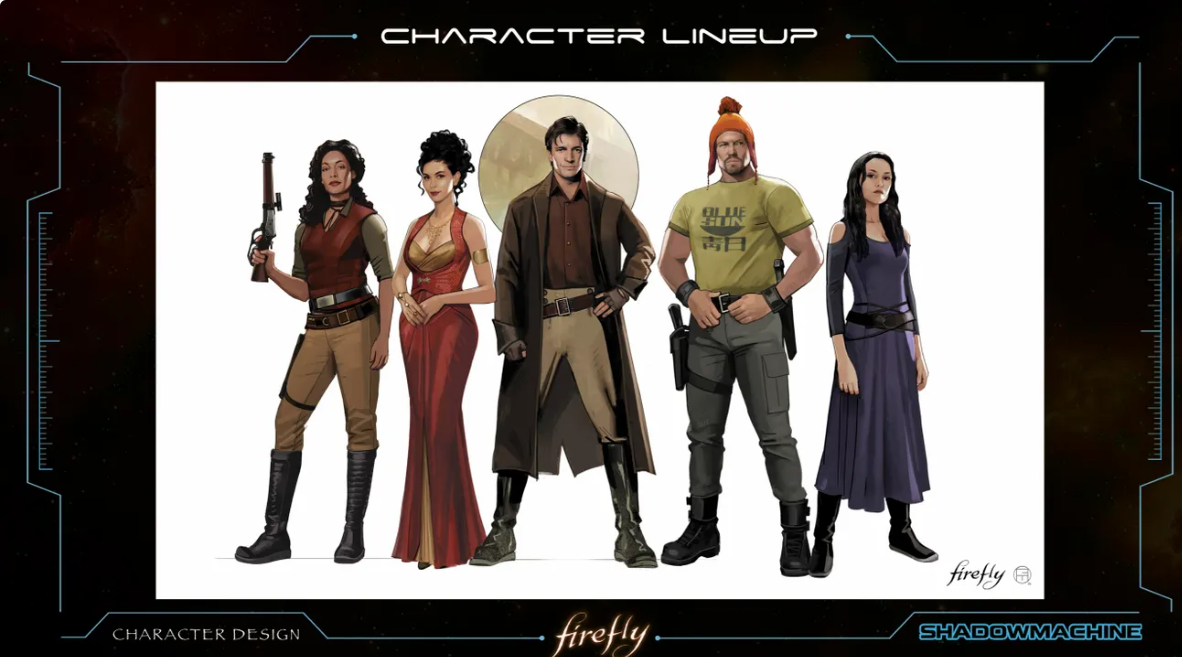 I’m excited. I’m reading that Hulu decided to cancel a planned Buffy reboot (never seen that show). But it proves nothing is guaranteed. Fillion is pitching it through his production company. Clearly, it’s got some quality names attached, with lots of inside connections. And a plan is in place. And an animated series certainly seems more doable than a live-action project. Those that are disappointed it’s not a live-action reboot, are living in a fantasy world. Reality precluded that in multiple ways. An animated series, with the original cast, still isn’t a done deal. But I don’t see how we could realistically have expected more. And Fillion and company delivered on all that buildup.
A life-long D&Der, I think Vox Machina is garbage, but it found a geek home on Prime. And there’s always SyFy (yes, it’s still around).
Firefly fans have wanted something since the day it was canceled. This is as solid as could have been reasonably hoped for. Gonna be a massively missed opportunity if it doesn’t happen. But the pieces are in place to get someone to say ‘Yes’ and then air it.
THE COLD HARD REALITY: Firefly had poor ratings. Serenity lost money at the domestic box office, and barely broke even globally. Firefly fans have been loud over the years. But they had better show up and make this a ratings hit, if they don’t want it cancelled quickly.
Fan numbers and dollars didn’t support Firefly, or Serenity. Those are facts, however much Fox screwed up the show, or promoting Serenity. There are no excuses for Browncoats not to make this a smash hit if it happens. A third financial failure and cancellation will establish that there is a core of fandom, but that Firefly isn’t a commercially viable project. Viewers and dollars matter. Not many properties get three chances.
IT’S A NEW IDES OF MARCH!
March 15 was the Ides of March. If this had been a disappointing ‘thing,’ it would have been linked to the Ides forever, like when Brutus and his buddies chopped up the first Caesar salad. Instead, if the animated series happens, it can make The Ides of March a happy day. Well, not for Caesar…
Can’t stop the signal. And the Browncoats are gearing up to support this. Let’s hope it happens.
 Bob Byrne’s ‘A (Black) Gat in the Hand’ made its Black Gate debut in 2018 and has returned every summer since.
His ‘The Public Life of Sherlock Holmes’ column ran every Monday morning at Black Gate from March, 2014 through March, 2017. And he irregularly posts on Rex Stout’s gargantuan detective in ‘Nero Wolfe’s Brownstone.’ He is a member of the Praed Street Irregulars, and founded www.SolarPons.com (the only website dedicated to the ‘Sherlock Holmes of Praed Street’).
He organized Black Gate’s award-nominated ‘Discovering Robert E. Howard’ series, as well as the award-winning ‘Hither Came Conan’ series. Which is now part of THE Definitive guide to Conan. He also organized 2023’s ‘Talking Tolkien.’
He has contributed stories to The MX Book of New Sherlock Holmes Stories — Parts III, IV, V, VI, XXI, and XXXIII.
He has written introductions for Steeger Books, and appeared in several magazines, including Black Mask, Sherlock Holmes Mystery Magazine, The Strand Magazine, and Sherlock Magazine.
You can definitely ‘experience the Bobness’ at Jason Waltz’s ’24? in 42′ podcast.
Is this thing on?
No comments on three consecutive posts.
TEST
I looked up the 3 posts in question and this is what I see:
– Eddie & the Cruisers
– Firefly animated reboot
– Clive Cussler and related action-oriented audiobooks
I guess the Firefly post is the most closely related to the “adventures in fantasy literature” Black Gate byline. Maybe that explains it.
Well, you’ve put two on this one, so you’re pushing the numbers up. Thank you kindly.
And since there’s been no on-screen Firefly for over 20 years, I’d say it’s pretty well-rested by now.
I put up a comment the day you posted this, Bob…and then deleted it myself an hour or two later, because it was mostly a gripe about the problems of “prequel/sequel/reboot” culture. After I thought about it I decided that I was being bad-mannered raining on your parade, and if I wanted to piss and moan, I should write my own piece and not do it on one of yours.
Maybe I should have left the comment up! At least it might have gotten the ball rolling…
Whedon has apparently given his blessing, but will not be involved. That’s too bad, it will suffer as a result.
I love Firefly, but I am ready to let it rest. No one has signed up to distribute this yet, so who knows what will happen.