Browsed by
Tag: science fiction

Is This Where John Norman Got His Inspiration?

Is This Where John Norman Got His Inspiration?

DSC_1549

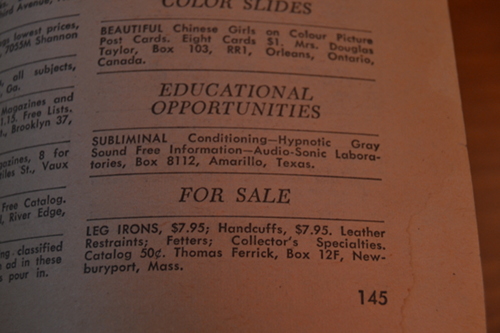
I spotted this in the classifieds at the back of the March 1962 issue of Amazing. Too bad I didn’t know about this when I met John Norman!


Sean McLachlan is a freelance travel and history writer. He is the author of the historical fantasy novel A Fine Likeness, set in Civil War Missouri, and the post-apocalyptic thriller Radio Hope. His historical fantasy novella The Quintessence of Absence, was published by Black Gate. Find out more about him on his blog and Amazon author’s page.

Segundo de Chomón: Forgotten Fantasist of Silent Film

Segundo de Chomón: Forgotten Fantasist of Silent Film

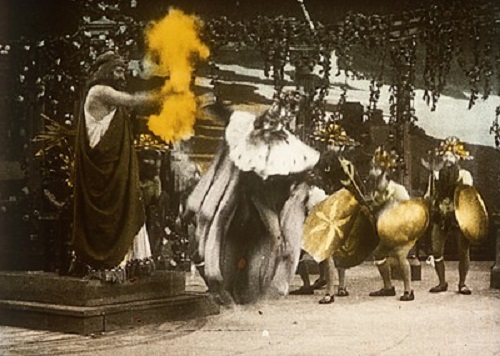
Voyage to Jupiter, 1909.

Fantasy, science fiction, and horror themes have been in the movies since almost the beginning. During the first few experimental years, movies consisted of simple scenes such as a man sneezing or a train pulling into the station, but soon that novelty wore off and audiences wanted stories. Since the medium itself seemed almost magical, directors began to experiment with the fantastic in order to tell gripping tales.

Most film buffs know of Georges Méliès and his 1902 Trip to the Moon, generally considered the first science fiction film. Méliès started out as a stage magician so it’s not surprising he added an element of the fantastic in his pioneering movies. Other early filmmakers such as Auguste and Louis Lumière and Thomas Edison tended to film realistic subjects or historical/adventure stories, although Edison did make a version of Frankenstein in 1910.

Lost amid these famous names is a man who did as much for the development of fantastic film as any of them. The Spanish director Segundo de Chomón pioneered many early special effects techniques and worked on some two hundred films. Having spent much of his career in France and Italy, he’s been claimed by no country and thus has fallen through the cracks of history.

Read More Read More

LonCon 3 Report: Attending the 72nd World Science Fiction Convention

LonCon 3 Report: Attending the 72nd World Science Fiction Convention

LONCON3_logo_270wLast weekend in London was LonCon 3, this year’s Worldcon. The convention, which has been held in various cities around the world since 1939, is where the Hugo Awards are given out and where fans from all over the globe meet up.

It was my first Worldcon, and while I’ve been to large conventions before such as World Fantasy and Eastercon, not to mention several local conventions such as Tuscon, I still wasn’t quite sure what to expect. What I got was five fun days of events, conversation, and camaraderie.

The Loncon staff did a fine job making everything run smoothly. A handy pocket guide steered me around the huge convention center without a hitch, and twice-daily newssheets kept me up-to-date on any changes.

There were only a couple of small minuses. First off, the dining options at the ExCel Centre were overpriced and generally substandard. Not that this is unusual for a convention center, so I don’t blame LonCon for this!

Also, the ExCel is huge and has all the ambiance of a shopping mall. But as Robert Silverberg pointed out, “Cons aren’t about venues, they’re about people.”

Read More Read More

The Public Life of Sherlock Holmes: When Elric of Melnibone Came to 221B Baker Street

The Public Life of Sherlock Holmes: When Elric of Melnibone Came to 221B Baker Street

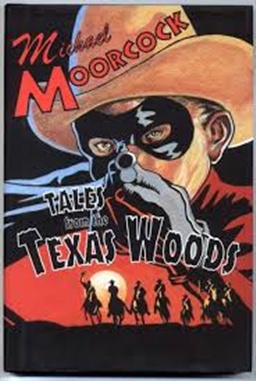
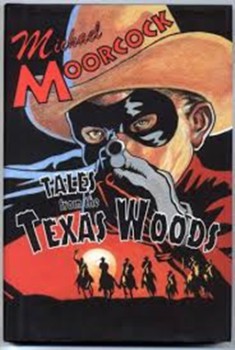
Moorcock_DorsetLodgerWell, not quite. That title was just to grab your attention. But Elric’s creator did set a tale at London’s most famous address, 221B Baker Street. And it’s a pretty ‘normal’ Holmes tale; which you might not expect from the guy who created Stormbringer.

I enjoyed Fletcher Vrendenburgh’s post last week on Michael Moorcock’s Eternal Champion. I devoured the tales of Corum, Hawkmoon, Erekose, and of course Elric in my middle-school years.

Being a Dungeons and Dragons player, these books were awesome. I think I even used Rackhir the Red Archer in a game. If you’ve not read  significant parts of that saga, your fantasy education is lacking.

Moorcock’s work encompasses much more than just the Eternal Champion tales. I’m a Christian and I was fascinated by the premise of The War Hound and all the World’s Pain (an excellent read: the sequel, not so much).

I even wrote a paper on the idea for a high school religion class. That got me an invite to see the teacher, a priest, after class.

Back in 1995, Moorcock wrote “The Adventure of the Dorset Street Lodger” as a privately printed chapbook which he let friends of his, who were opening a hotel on Dorset Street, give away to their first guests.

Read More Read More

The Public Life of Sherlock Holmes: Sherlock (Doctor) Who?

The Public Life of Sherlock Holmes: Sherlock (Doctor) Who?

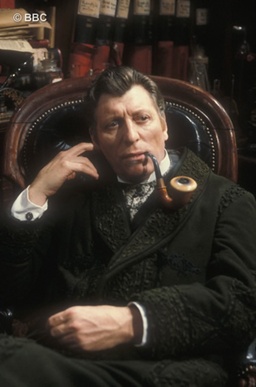
Baker_PipeThe BBC recently held a ‘Best of Doctor Who 50th Anniversary Poll’ and Tom Baker came out number one. This is a bit surprising, as he roamed in the Tardis from 1974 to 1981, which was over three decades ago. And less relevant but still of note is that the Doctor never really broke big in America until David Tenant took on the role.

Baker_Moore
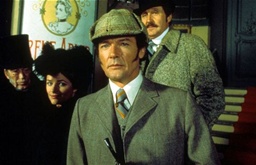
Roger Moore starred in the TV movie Sherlock Holmes in New York. It’s not quite as bad as it might appear, though John Huston was woefully miscast as Moriarty.

After Baker gave the Doctor up for regeneration, the BBC approached him and asked what project he would like to do next with his popularity still soaring. Baker immediately replied, “Sherlock Holmes,” and traded his scarf for a deerstalker.

With England’s most iconic actor (sorry, Roger Moore) to play England’s most iconic character (sorry, James Bond), only the biggest Holmes story would do. Though that’s not the smartest choice to showcase Holmes.

The BBC hadn’t tackled The Hound of the Baskervilles since Peter Cushing’s second attempt at it for his 1968 television series (a role he secured after failed attempts to land Robert Stephens and Eric Porter). There had been an American TV version in 1972 starring a dull Stewart Granger with Bernard Fox as yet another doofus Watson who mumbled his lines.

Read More Read More

Blogging Dan Barry’s Flash Gordon, Part Fifteen

Blogging Dan Barry’s Flash Gordon, Part Fifteen

Flash Alpha 1Flash Alpha 2“Return to Mongo” by Dan Barry was serialized by King Features Syndicate from January 2 to March 24, 1956. The story gets underway with a party celebrating Dr. Zarkov’s newly discovered young adult daughter Zara and her arrival on Earth after growing up on an otherwise deserted swamp planet with her mother. Flash, Dale, and the Space Kids are at the party when Zarkov is alerted to the discovery that Mongo is once again entering Earth’s orbit and threatening our world’s stability. Willie, who still has the ability to psychically grant wishes, inadvertently teleports everyone from the party to Mongo.

Flash and the Space Kids are immediately set upon by Queen Azura’s cowled servants, who nearly massacre them. Working as a team to defeat Azura’s servants, Flash and the Space Kids are overcome by a paralyzing gas as they explore a nearby cave. They are subsequently captured and brought to Queen Azura’s palace, where they learn she is plotting to overthrow Prince Barin.

Read More Read More

Blogging Dan Barry’s Flash Gordon, Part Fourteen

Blogging Dan Barry’s Flash Gordon, Part Fourteen

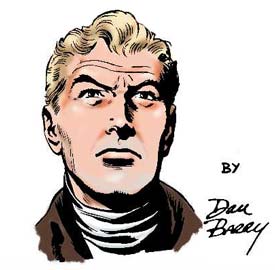
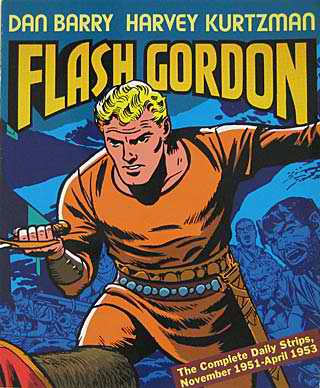
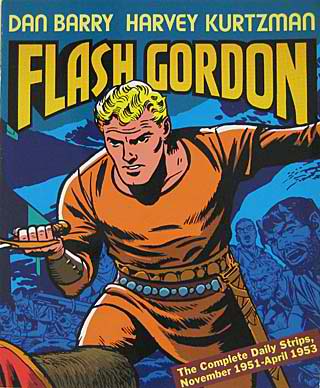
Barry Gordonkurtzman_flash_gordon_cvr11“The Swamp Girl” by Dan Barry was serialized by King Features Syndicate from October 31 to December 31, 1955. Just as Dan Barry guided the strip closer to its origins, he took two sidesteps in introducing a back-story for Dr. Zarkov that Alex Raymond never intended. “The Swamp Girl” introduces us to a hot-tempered, beautiful young woman called Zara, whose mother was the sole survivor when her rocket crashed on the swamp world of Malagua twenty years before.

As the story begins, Lisa (Zara’s mother) is succumbing to malaria just as her daughter has finally succeeded in repairing their rocketship. Zara sets off to visit her father’s home world of Earth and fulfill her mother’s dying request that her daughter bring the father she has never met to see her mother before she dies, so that her mother may reconcile with him.

Zara arrives on Earth with her pet black panther, Octavio. Their ship’s coordinates take them to the desert town where Zara’s father, Dr. Zarkov, lives. After upsetting the neighborhood and evading the police, both the swamp girl and her panther reach their destination.

Read More Read More

Blogging Dan Barry’s Flash Gordon, Part Thirteen

Blogging Dan Barry’s Flash Gordon, Part Thirteen

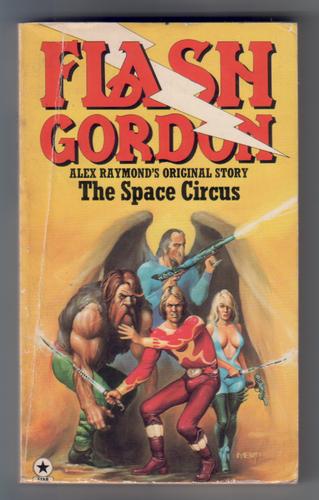
Space Circus tradSpace Circus alt“Space Circus” by Dan Barry was serialized by King Features Syndicate from September 5 to October 29, 1955. “Space Circus” is significant for being the first time in the Dan Barry strips where Flash’s past adventures on Mongo are now an integral part of the storyline. One wonders if reader response prompted King Features to request a change of direction from what would today be considered a reboot to a direct sequel to the original storyline of the early 1930s.

“Space Circus” gets underway with Flash abducted by a flying saucer while out driving on a desert road late one night. Abduction by UFO was a relatively new concept in the 1950s, but one that was spreading rapidly as a fear that many shared during the Cold War era. The aliens are from the planet Mesmo and appear as Asian caricatures. While a number of the inhabitants of Mongo were depicted as Asian in appearance, they were portrayed as being exotic and not as demeaning cartoonish representations. While there were certainly many more offensive Yellow Peril figures in comics of the era, the Mesmans are a far cry from the seductive and imposing inhabitants of Mongo as Alex Raymond portrayed them.

Read More Read More

Blogging Dan Barry’s Flash Gordon, Part Twelve

Blogging Dan Barry’s Flash Gordon, Part Twelve

Barry Gordonkurtzman_flash_gordon_cvr11“Starling” by Dan Barry was serialized by King Features Syndicate from July 11 to September 3, 1955. “Starling” starts off with Flash visiting Dr. Zarkov one evening to find his old friend depressed, as the U.S. Government has turned down his request for an additional million dollars funding to finish construction of the Super-S Rocket. It is a nice hint of direction for the strip to come, which will take the series closer to its roots. Flash and Zarkov are startled by the discovery of a prowler outside, but the man gets away.

Over the next few days, similar disturbing incidents occur. Flash and Dale are nearly run down by a speeding car while out walking one afternoon on the grounds of Zarkov’s estate. Later, a crate is dropped off the roof of a downtown building when Flash is walking beneath and just misses him. Shortly thereafter, Zarkov receives a telephone call from B. B. Remsen, the billionaire industrialist requesting an interview with Flash.

Upon visiting Remsen’s estate, Flash is outraged to discover Remsen hired his goon, Byron, to test Flash’s reflexes by nearly running him down with a speeding car and dropping a crate off a building. Byron was the prowler at Zarkov’s estate who learned of the need for financing for the Super-S Rocket. Remsen agrees to finance the rocket if Flash will take on a unique assignment. Remsen’s very wild granddaughter, Starling, wants to travel in space and Remsen wants Flash to pilot the rocket that will take her to the stars.

Read More Read More