Modular: A First Look at Starfinder 1: “OMG! All Your Trope Are Belong To Us”
“Dad, we can’t get the Starfinder combat system working…”
“Look, Son, it’s a D20 system, so Armor Class reduces the chance of being hit, rather than absorbs damage.”
“OK. I get it now! You’re the best, Dad!”
(Tousles hair) “That’s what Dad’s are for, Son.”
OK it didn’t quite go like that. For a start, I did not in fact tousle my 13-year-old son’s hair since (a) it’s shoulder length and he gets cross if you tangle it, and (b) he’s 13. Even so, it was a “life’s full circle” Country and Western moment of the same order as when non-geeks teach their kids to throw a rabbit or skin a baseball or whatever.
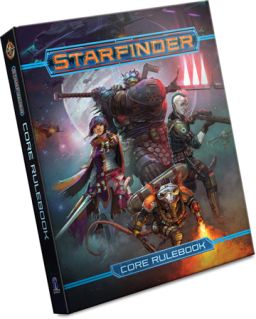
However, Kurtzhau was indeed encountering a D20 system for the first time, the engine at the heart of Starfinder, Paizo’s new Science Fantasy (it uses that term in the text!) system, with which he’s pretty much fallen in love. The blurb says it all.
The Starfinder Roleplaying Game puts you in the role of a bold science-fantasy explorer, investigating the mysteries of a weird and magical universe as part of a starship crew. Will you delve for lost artifacts in the ruins of alien temples? Strap on rune-enhanced armor and a laser rifle to battle undead empires in fleets of bone ships, or defend colonists from a swarm of ravenous monsters? Maybe you’ll hack into the mainframe of a god-run corporation, or search the stars for clues to the secret history of the universe or brand new planets to explore. Whether you’re making first contact with new cultures on uncharted worlds or fighting to survive in the neon-lit back alleys of Absalom Station, you and your team will need all your wits, combat skill, and magic to make it through. But most of all, you’ll need each other.
Inspired by my son’s enthusiasm, I decided to take a look myself…