Cover for Divide and Rule by N. Taylor Blanchard Cover for The Sword of Rhiannon by A.C. Farley
The seventeenth Tor Double, includes two stories, L. Sprague de Camp’s Divide and Rule and Leigh Brackett’s The Sword of Rhiannon, which are both fantasy stories masquerading as science fiction.
Divide and Rule was originally serialized in Unknown in April to May, 1939. Divide and Rule is the first of two de Camp stories to be published in the Tor Doubles series. It includes de Camp’s first of two stories in the series (both of which will be reviewed this month) and Brackett’s second of three.
Cover for The Color of Neanderthal Eyes by Dave Archer Cover for And Strange at Ecbatan the Trees by Brian Waugh
And Strange at Ecbatan the Trees was originally published as a stand-alone novel by Harper & Row in March, 1976. The story lends takes its title from the poem “You, Andrew Marvell,” written by Archibald MacLeish, which also provided the title for Black Gate contributor Rich Horton’s blog. The poem is a look at the transience of empires, and Michael Bishop’s story follows suit.
In fact, published in the month following Vance’s The Last Castle and Silverberg’s Nightwings, And Strange at Ecbatan the Trees almost gives the feeling that the Tor Double series was a collection of stories about the collapse of civilization. In And Strange at Ecbatan the Trees, Michael Bishop describes and alien world which was settled by humans fleeing Earth six millennia before. By the time of the novella, they have split into warring factions and outright battle appears to be just over the horizon.
Warriors of Noomas (Powell, May 1969). Cover by Albert Nuetzel
Back when the internet was young and I was in a group called REHupa, The Robert E. Howard United Press Association, I heard about Charles Nuetzel, who’d written some Howard-like and Burroughs-like tales.
I’d stumbled on his book called Warriors of Noomas. After a search on the net, I found an email address and sent one flying into the void. I wasn’t sure he was even alive, but he answered and we became frequent correspondents and friends. He too was a huge fan of Edgar Rice Burroughs and quite a bit of his writing was ERB inspired. He’d become a pulp writer and book packager for Powell Publications.
Cover for The Last Castle by Brian Waugh Cover for Nightwings by Mark Ferrari
The Last Castle was originally published in Galaxy in April, 1966. It won the Hugo Award and the Nebula Award. The Last Castle is the first of two Jack Vance stories to be published in the Tor Doubles series.
The Last Castle is set on a future Earth that humans have abandoned and later returned to. With their return, they brought a civilization which was based on a strong caste system Gentlemen were humans who lived in the castles which were established across the planets. Other humans, Nomads and Expiationists, lived outside the castles and were viewed as barely more than animals. Serving the Gentlemen in the castles were the Peasants, Phanes, Birds, and Mek, various races which were brought back to Earth with the humans in order to perform certain tasks.
Lin Carter’s Under the Green Sun series (DAW Books)
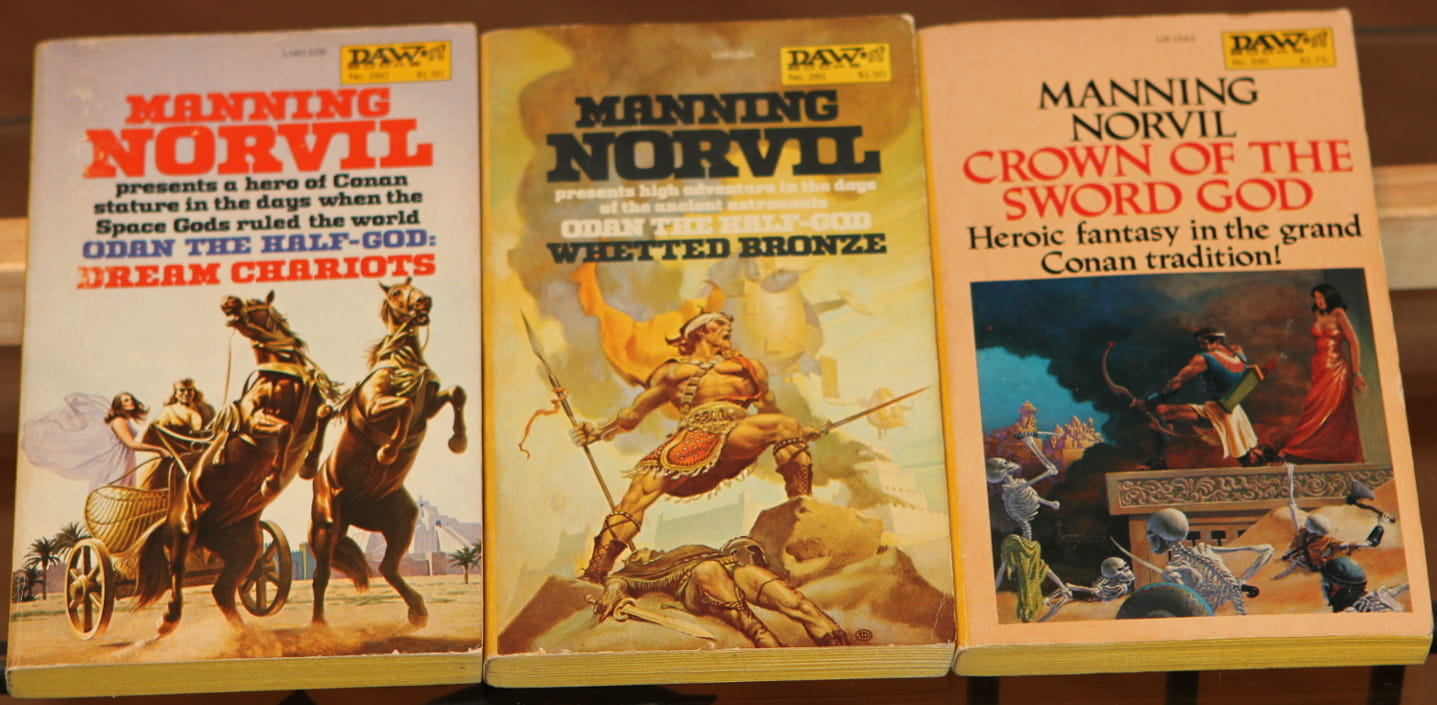
I consider Edgar Rice Burroughs and Otis Adelbert Kline to be the first generation of Sword & Planet authors. Probably most widely known among the second generation — whether rightly or wrongly — is Lin Carter. Carter was an enthusiastic fellow who loved all things fantasy, including S&P and Sword & Sorcery. He promoted the genres, edited many collections of fantasy stories, and was a tremendously prolific author himself.
I’ve read 41 books by him and still have about a dozen on my TBR shelves. And that’s NOT counting the Conan books he was associated with. He was everywhere when I was growing up and our small town library had more books by him than by ERB himself.
This book is predominantly concerned with making money, and from its pages a reader may learn much about the character and the literary integrity of the authors. Of boggies, however, he will discover next to nothing, since anyone in the possession of a mere moiety of his marbles will readily concede that such creatures could exist only in the minds of children of the sort whose childhoods are spent in wicker baskets and who grow up to be muggers, dog thieves, and insurance salesmen. Nonetheless, judging from the sales of Prof. Tolkien’s interesting books, this is a rather sizable group, sporting the kind of scorch marks on their pockets that only the spontaneous combustion of heavy wads of crumpled money can produce. For such readers we have collected here a few bits of racial slander concerning boggies, culled by placing Prof. Tolkien’s books on the floor in a neat pile and going over them countless times in a series of skips and short hops. For them we also include a brief description of the soon-to-be-published-if-this-incredible-dog-sells account of Dildo Bugger’s earlier adventures, called by him Travels with Goddam in Search of Lower Middle Earth, but wisely renamed by the publisher Valley of the Trolls.
from the Prologue — Concerning Boggies from Bored of the Rings
My introduction to Bored of the Rings (1969, a scatalogical, offensive, and dated, but hilarious, parody of The Lord of the Rings), came at the hands of a friend of mine, Karl H., during a Boy Scout camping trip in the late seventies. My first memory of Karl is him at 8 years old being carried kicking and yelling over the school custodian’s shoulder after he’d been caught trying to scale the back fence. Two years older than me, we stayed friends until he graduated high school in 1982. I saw him once more after that before he disappeared into the wilds of the West Coast. When first his sister, and then his mother passed away, I didn’t find out until weeks after the fact and missed both funerals and him.
Cover for The Saturn Game by NASA Cover for Iceborn by Marx Maxwell
The Saturn Game was originally published in Analog in February, 1981. It was nominated for the Hugo Award and the Nebula Award, winning the latter. The Saturn Game is the second of three Anderson stories to be published in the Tor Doubles series after No Truce with Kings.
In 1978, Andre Norton published the novel Quag Keep, widely considered to be the first representation of role playing games in fiction. Norton’s story had a role player fall into Gary Gygax’s World of Greyhawk and live out the sort of adventures that occur in role playing games. By 1981, role playing had become more broadly established, although still niche, especially when compared to today’s popularity. In 1981, Larry Niven and Steven Barnes published Dream Park, in which an amusement park ran what were essentially Live Action Role Playing Games. In the same year, Poul Anderson published The Saturn Game, in which a fantasy role playing game was used in a variety ways on a mission to Saturn.
The Saturn Game begins in the middle of a role-playing session as Anderson’s characters are killing time during the long journey to Saturn. In this sequence, Anderson introduces the reader to the characters, both who they are and who they portray in the game. One of the intriguing things about the importance of the game to the characters is that they are living an adventure: the flight to Saturn, but still feel the need to escape into their world of adventure, although not all of the characters play the game. …
Cover for The New Atlantis by Michael Böhme Cover for The Blind Geometer by Peter Gudynas
The New Atlantis was originally published in The New Atlantis and Other Novellas of Science Fiction, edited by Robert Silverberg and published by Hawthorn Books in May, 1975. It was nominated for the Hugo Award and the Nebula Award and won the Locus poll.
The story opens with Le Guin’s narrator, Belle, returning home from a Wilderness Week aboard a bus where another passenger attempts to engage her in conversation, noting that a new continent is rising in the ocean, either the Atlantic or Pacific, but scientists have little information about it to go on. This exchange allows Le Guin to provide the reader with information about the climate change that is affecting her world. Manhattan underwater and parts of San Francisco are flooded.
Dray Prescot #17-24, all from DAW: Captive Scorpio (1978), Golden Scorpio (1978), A Life for Kregen (1979), A Sword for Kregen (1979), A Fortune for Kregen (1979), A Victory for Kregen (1980), Beasts of Antares (1980), and Rebel of Antares (1980). Covers by Josh Kirby (#17-18), Richard Hescox (#19-23), and Ken Kelly (#24)
Not only is the Dray Prescot series the longest running Sword & Planet series ever published in English, but it’s also consistently of a high quality. There are quite a few volumes that — for me—rival any of Edgar Rice Burrough’s Barsoom books. Certainly, these two series are my all-time favorites, and together make up the primary influence on my own Sword & Planet series, the five books of the Taleraseries by Charles Allen Gramlich (Gotta get those “three” names in there.) I’ve posted about the Talerabooks before, but back to Kenneth Bulmer (who wrote the Prescot series as ‘Alan Burt Akers’) and Dray Prescot now.
I’ve never been one to put a lot of emphasis on covers, but the Bladud books, all five compendiums containing the last fifteen novels, have the same cover image with just a change in the color of the dust jacket. This made me long for the original DAW publications where each vibrant cover was tied directly to the book it illustrated.
The Language of the Night: Essays on Fantasy and Science Fiction by Ursula K. Le Guin
(trade paperback reprint from Perigee Books, 1980). Cover by Michael Mariano
I’m not a big fan of literary criticism in any field (although I have committed some), but one of my big books from my late teens onward was Le Guin’s The Language of the Night (1979), especially for the essays “From Elfland to Poughkeepsie” and “A Citizen of Mondath.”
Le Guin has some great passages in “Citizen” about what she liked to read as a kid, and how she liked it.