IN A DISTANT AND SECONDHAND SET OF DIMENSIONS, in an astral plane that was never meant to fly, the curling star-mists waver and part…
See…
Great A’Tuin the turtle comes, swimming slowly through the interstellar gulf, hydrogen frost on his ponderous limbs, his huge and ancient shell pocked with meteor craters. Through sea-sized eyes that are crusted with rheum and asteroid dust He stares fixedly at the Destination.
In a brain bigger than a city, with geological slowness, He thinks only of the Weight.
Most of the weight is of course accounted for by Berilia, Tubul, Great T’Phon and Jerakeen, the four giant elephants upon whose broad and star-tanned shoulders the Disc of the World rests, garlanded by the long waterfall at its vast circumference and domed by the baby-blue vault of Heaven.
Astropsychology has been, as yet, unable to establish what they think about.
So begins The Colour of Magic (1983), the first volume of the eventually forty-one-book-long Discworld series by Terry Pratchett. I was lent this book (along with another Pratchett book, Strata (1981), which I’ve still never read — or returned, possibly) back in 1985 when it first hit US shores. He said it was funny and it was.
I hadn’t laughed much during earlier run-ins with fantasy and sci-fi comedies, save for Douglas Adams’s The Hitchhiker’s Guide to the Galaxy. Too often, puns were what passed for wit and the satire was shallow. Returning to Colour for the first time in many years, I’m impressed with how sharp Pratchett’s eye was when it came to picking his genre targets and just how good his prose was. His writing would become more complex, deeper, and much darker over the decades, but already, it’s witty and effervescent. In an age of such po-faced seriousness, we could use more of it.
Nightfrights (Peacock/Penguin, 1975). Cover by David Smee
They say that science fiction and fantasy readers love to identify with their heroes. To imagine themselves learning that they’re a wizard, attending Hogwarts School of Witchcraft and Wizardry. Or being called to participate in The Hunger Games, or captain a starship.
I get it. I’m 59 years old, and the instant I saw the cover of the 1975 edition of Nightfrights I identified with the wide-eyed old coot on the cover. That’s what qualifies as an intrepid hero I can identify with these days. Awakened in the middle of the night, called upon to investigate the inhuman shrieks in the backyard, telling ourselves it’s just raccoons but knowing in our heart that’s it’s ghouls. Or Bughuul, from that Sinister movie I just watched on Prime. Or our neighbor Jerry, driven mad by fumes from his lawnmower. Don’t come any closer Jerry, I’ve got Alice’s rolling pin, and I know how to use it.
War in Heaven (Bantam Spectra, January 1998). Cover by Dean Williams
David Zindell came out of the gate strong as a young science fiction writer in the 80s and 90s. He was nominated for the John W. Campbell Award for Best New Writer in 1986, and his debut novel Neverness won instant and wide acclaim. Edward Bryant said it “Propels him instantly into the big leagues with the likes of Frank Herbert and Ursula K. Le Guin,” and Kirkus Reviews gushed “Zindell succeeds brilliantly… in his convincing portrayal of what a super-intelligent being might be like…. Vastly promising work.” On the basis of that single novel, Gene Wolfe called Zindell “One of the finest talents to appear since Kim Stanley Robinson and William Gibson — perhaps the finest.”
Zindell followed up Neverness with a sequence set in the same universe, A Requiem for Homo Sapiens. War in Heaven (1998) was the last book in the series — and in fact the last science fiction book he ever wrote. At least until he returned to the genre this year, with his first new SF novel in a quarter century, The Remembrancer’s Tale.
The Year’s Best Horror Stories: Series XIII (DAW Books, October 1985). Cover by Michael Whelan
The Year’s Best Horror Stories: Series XIII was the thirteenth in the DAW Year’s Best Horror series, and the sixth edited by the great Karl Edward Wagner (1945–1994). The book was copyrighted and printed in 1985. Michael Whelan returns as cover artist after taking a hiatus from Series XII. This marked Whelan’s tenth cover for the series! The newest cover is more fantasy than horror with an elf or goblin-like human playing a bone as a flute in a Pan-like fashion. There is a darkness to the art that is suggestive of horror or darker fantasy. Whelan’s diverse choice of artistic topics for horror does not disappoint.
This volume contained seventeen different authors. All male. Nine were American, six were British, and there is one returning Canadian author, Vincent McHardy and a returning German-born author, David J. Schow. Six of these stories came from books. Another six came from professional magazines. Two came from fanzines, one from a convention program, one from a chapbook, one from a journal, and one from a comic book. Considering the pre-internet era of this volume, Wagner is impressive in that he seemed to read everything from everywhere, looking for good horror.
The Mind Spider and Other Stories and Ships to the Stars (Ace Books, 1976). Covers by Walter Rane
Last year I discussed the marvelous collection The Worlds of Fritz Leiber, published by Ace in 1976, and was astounded to find the author make this claim in the introduction.
I believe this collection represents me more completely, provides a fuller measure of the range of my fictional efforts, than any other. I’ve tried to make it that way, without repeating stories from other collections, especially the ones currently in print. There no overlap with those whatsoever. (Overlapping collections are an annoyance to readers and authors alike.)
Leiber had more than half a dozen collections in print in 1976, including five volumes of Fafhrd and the Gray Mouser tales, two volumes of The Book of Fritz Leiber (DAW, 1974 and 1975), The Best of Fritz Leiber (Del Rey, 1974), and the two collections we’re discussing today, The Mind Spider and Ships to the Stars.
How is it possible to assemble a world-class retrospective and avoid any overlap with his other popular collections? I guess the only way to do it is to be Fritz Leiber.
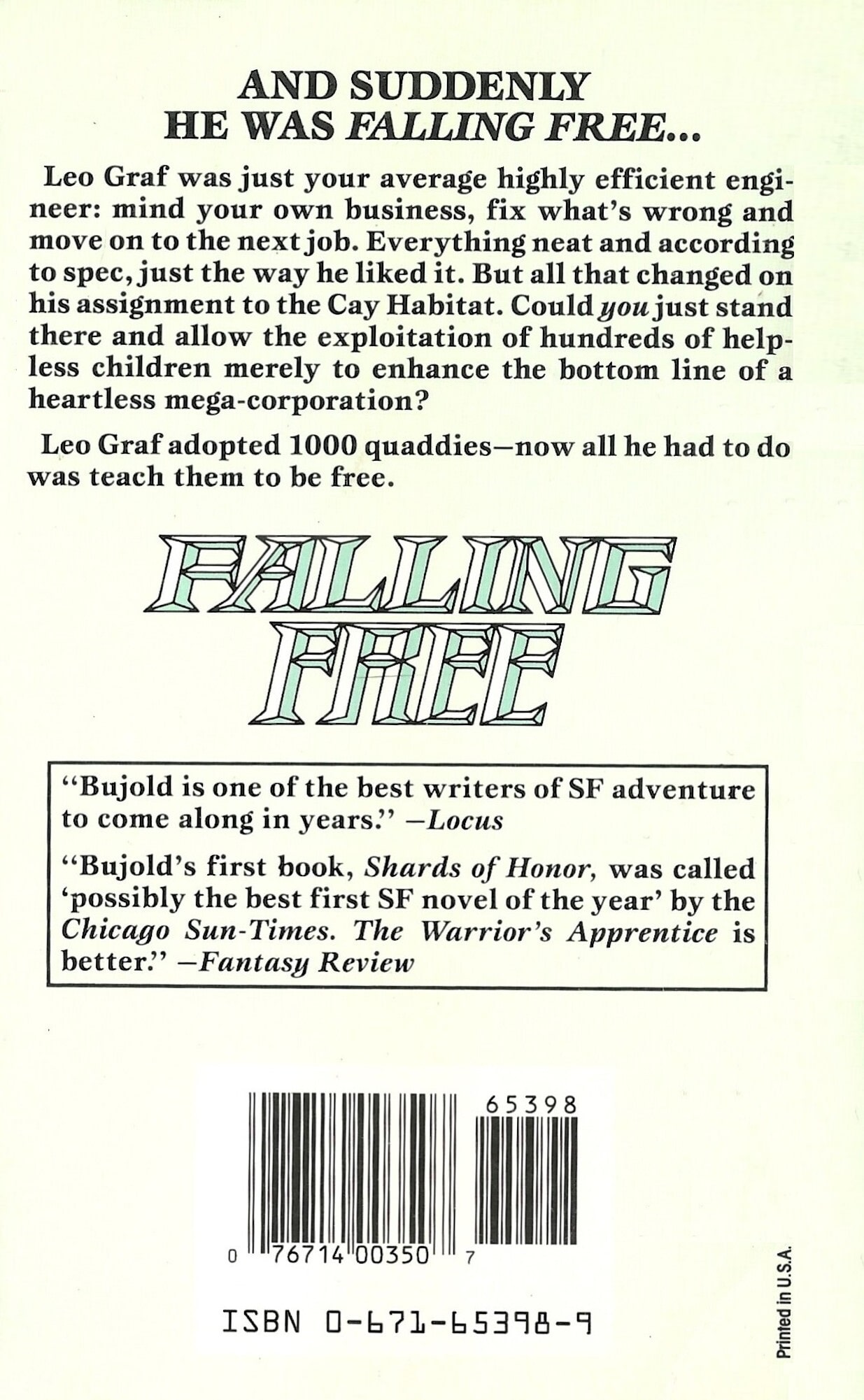
Phaid the Gambler (Ace Books, August 1986). Cover by Jim Gurney
Mick Farren was a fascinating guy.
He was the singer for the UK band The Deviants in the 60s, and released two solo albums in the late 70s, and a live album in 2005. He began his writing career in the early 1970s as a journalist for the UK Underground press, and eventually the mainstream New Musical Express. By the end of the 70s he was supporting himself as a full time writer, and over a 30-year career he published 23 novels before his death in 2013 at the age of 69. He died after collapsing on stage during a Deviants concert in London in July 2013.
The Gate of Ivory, Two-Bit Heroes, and Guilt-Edged Ivory (DAW Books, 1989-1992). Cover art by Richard Hescox
Doris Egan is a successful screenwriter and producer with a very impressive resume. She’s worked on dozens of shows since the early 90s, with screenwriting credits on Dark Angel, Smallville, Numb3rs, House, Torchwood, Black Sails, and The Good Doctor. She was a producer for Smallville, NCIS, Skin, Tru Calling, House, Krypton, Swamp Thing, and many others.
But before Hollywood came calling, she was a fast-rising science fiction author. Her debut novel The Gate of Ivory (1989) — the tale of an anthropology student stranded on the isolated planet Ivory, the only place in the galaxy where magic actually works — was nominated for a Locus Award and the Compton Crook Award for Best First Novel, and was followed in rapid succession by Two-Bit Heroes (1992) and Guilt-Edged Ivory (also 1992).
While Egan’s Hollywood career made her the envy of every midlist SF writer, there are those of us who wonder what science fiction lost when she was lured to Tinseltown.
Mustapha and His Wise Dog (Avon, July 1985). Cover art by Richard Bober
You always remember your first time.
Indeed you do, even when it’s actually your second time, but we’ll get to that.
My first novel to see print was Mustapha and His Wise Dog, a fantasy set in the world of the Twelve Kingdoms. The series got its start when I should have been doing my homework. I blame my friend Shariann Lewitt (a.k.a. S.N. Lewitt). Picture it: Yale University, the 1970s. We were both a part of a group of friends who ate together in the dining room of the Hall of Graduate Studies. We might have come from different departments (Spanish, Linguistics, Computer Science, Philosophy, to name but a few) or even different schools (Shariann attended the Yale School of Drama) but we enjoyed each other’s company and became the self-dubbed Stream of Consciousness Table.
The Encyclopedia of Science Fictioncalls Derleth “one of the pioneering anthologists in the genre.” He began his editing career with horror collection Sleep No More in 1944. Strange Ports of Call, which drew heavily from pulps such as Astounding, Wonder Stories, Amazing, The Black Cat, Planet Stories, and others, was his first SF volume. It was a success, and so was the Berkley paperback, and very quickly the formula was set. Over the next six years Derleth produced six more SF anthologies, all of which drew heavily from pulp magazines, and all of which were released in paperback — packaged and heavily abridged with machine-like precision to hit a 172-174 page count and a profitable 35-cent price point.
Time to Come was something different. Derleth’s first original science fiction anthology, it contained brand new stories by the biggest writers of the day, including Poul Anderson, Isaac Asimov, Charles Beaumont, Arthur C. Clarke, Philip K. Dick, Carl Jacobi, Ross Rocklynne, Robert Sheckley, and Clark Ashton Smith. Like the others it was very successful, remaining in print in multiple editions for 15 years.
Some of the September 22 estate sale finds made by Deb Fulton
Deb’s Part of the Story
I almost skipped this estate sale, which was held on September 22, 2022. The meat of the description posted online was model railroad items, with a side dish of old radios and parts. The few pictures that showed books were not particularly encouraging. Typical of estate sale companies, there was not enough detail in the pictures to read the title or author on the spines or covers of the few books shown.
Atypical of estate sale companies, the description had a little detail — it mentioned Tarzanbooks and “other books” from the ‘20s/’30s. But what I saw smacked of reprint editions, and that was not exciting enough for a fifty minute drive (each way). A brief consultation with Doug confirmed my view.