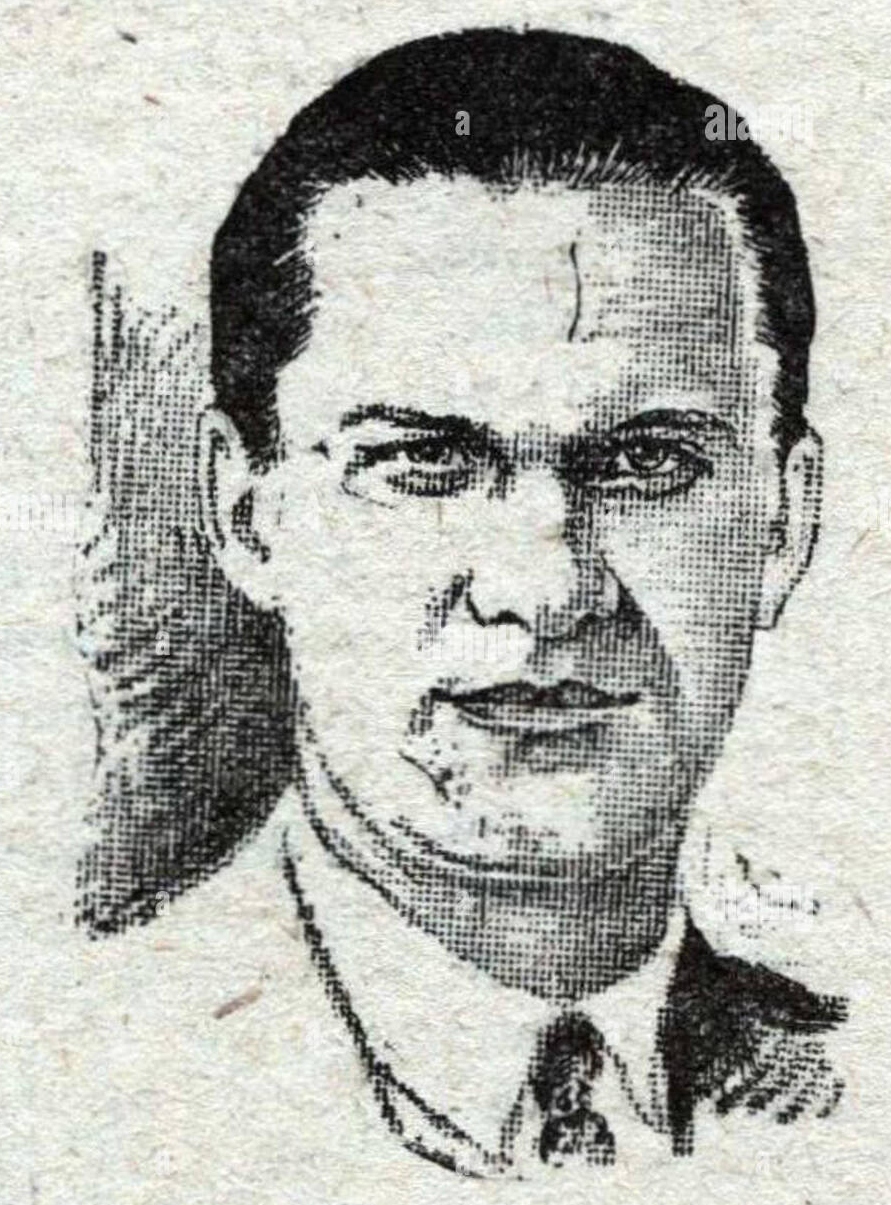
Edwin K. Sloat was born on March 1, 1895 in Denmark, Iowa.
The attended State Normal College in Edmond, Oklahoma (now University of Central Oklahoma), graduating in 1916. Following his graduation, he worked as a newspaperman, an employee of the post office, and as a band leader during World War I, in which he was a Musician 1st Class Petty Officer.
After the war, he married Corinne Evelyn Lake in 1922 and they had two sons, Jerry and Donald.
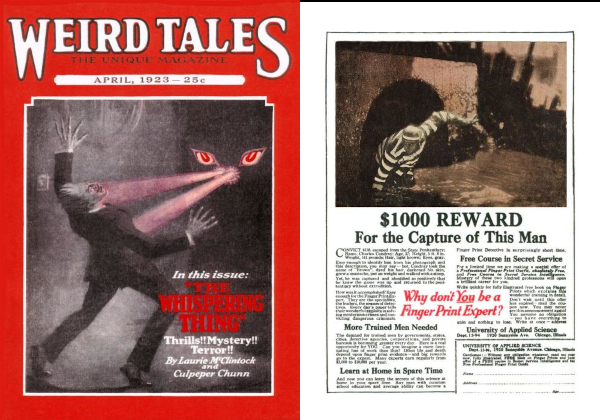
The second issue of Weird Tales, on sale from March of 1923 through to April, looked much like the first: a pulp magazine roughly 6 and a half inches by 9 and a half, with 192 pages. The April issue was .75 of an inch shorter and half an inch narrower. The black-white-and-red cover was more striking than the previous issue’s, with the main image contained in a thick red frame, and the date and price more easily visible under the title. There was a new and smoother-looking logo. Unlike the first issue, this cover didn’t share a format with that month’s issue of Weird Tales’ older sister publication Detective Tales. Although to phrase it that way may be misleading; John Locke, in The Thing’s Incredible! The Secret Origins of Weird Tales, argues that what is referred to as the April/May 1923 issue of Detective Tales was actually an issue that came out in May which the publisher retroactively dated as a bimonthly issue, and if that’s so then there was no Detective Tales issue in April for the second issue of Weird Tales to parallel.
Either way, the cover’s about all you might hope for from a magazine called Weird Tales. Mysterious gigantic eyes stare out of darkness, while from just below them pink rays shoot out to strike a man who screams and throws out his hands. It’s not terribly sophisticated — background details are nonexistent or lost in the ink wash, and you can’t help but wonder if the mysterious creature in shadows is firing rays from its nostrils. But it is an image that tells you things supernatural and horrific lurk within these pages.
This post will take a look at the physical and editorial package of the second issue of Weird Tales, with an eye to tracking the magazine’s evolution. It’ll run long, because I’ve included numerous extracts from pulp magazine editorials — mostly for the sake of making an argument about how Weird Tales was positioning itself in its marketplace, but partly, I have to admit, for historical interest and potential amusement value.
This post is the second in a series reflecting on the world of 1923 as a background to early issues of Weird Tales. Imagine that you’re an American in February of 1923, and you’re taking a walk to the newsstand to buy the first issue of a new pulp fiction magazine. What sort of things will you see?
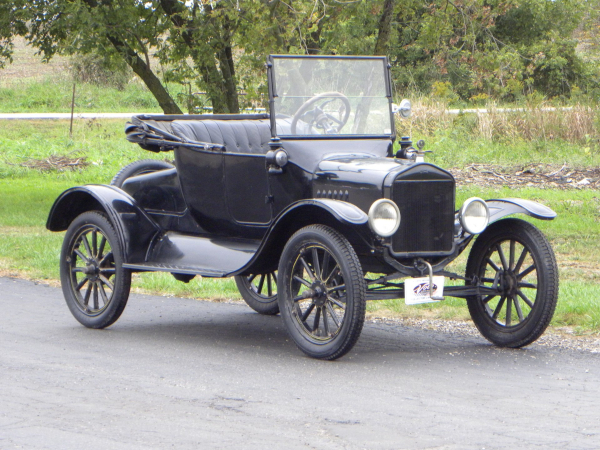
Probably the first thing you’ll notice as you set out into the street is the street itself, and its contents. The motor car has begun to change urban life. Since Ford introduced the Model T fifteen years ago the price has steadily dropped; there were almost 11 million registered passenger automobiles in the United States by the end of 1922, and will be just shy of 13.5 million by the end of 1923. Cars are registered, incidentally, and license plates have been required since 1918, but most states do not issue driver’s licenses; half the states will require licenses by 1930, and as late as 1935 only 39 states will mandate licenses and not many of those will require passing a test. In 1923 Model Ts are still the most common make of car, though competing models are about to cut into its sales. Famously, you can get a Model T in any colour, so long as it’s black; Ford used to offer a range of colours, but in 1914 streamlined production by cutting back to a particular type of black paint that was cheap and fast-drying. Model Ts do not at this time have shock absorbers, windshield wipers, rear view mirrors, bumpers, or an instrument panel for a speedometer (not a standard feature) or gas gauge.
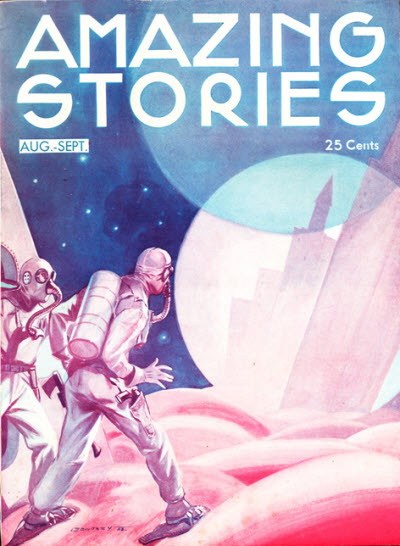
Amazing Stories, August-September 1933, cover by Leo Morey
This week starts a brief period where these explorations are going to be shorter, for many of these authors have little biographical information available.
In the 1972 anthology Clarion II, Damon Knight included an essay entitled “Goodbye, Henry J. Kostkos, Goodbye,” using the author, along with J. Harvey Haggard, as an example of an author he once read and was invested in, but whose name no longer meant anything to modern readers. At the time, both Kostkos and Haggard were alive (Haggard would be alive for another 29 years).
Henry J. Kostkos was born on June 11, 1900.
Kostkos and his wife, Mary, had two children, Miriam and Maureen. Kostkos worked for Western Electric as an electrical engineer as well as for Bell Labs in Chicago and Ohio. He worked on display mechanisms developed by Bell Labs for their associated telephone companies. At various times, he ran his own contracting business in New York and in Chicago.
Uncanny Magazine cover collage Year 13 (issues 67, 68, and 72). Covers by Paul Lewin, Katy Shuttleworth, and Galen Dara.
This wasn’t my original plan for this guest post. The day before writing this, I was interviewed for the Functional Nerds podcast. During the interview, cohost Tracy Townsend brought up my recent Uncanny Magazine editorial where I said, “Nobody would call a yearly referendum about whether or not your business should exist a stress-free process.” Tracy wanted to know why I kept doing this if that’s the case.
Weird Tales volume 1 number 1 boasts 26 separate pieces of fiction, one of which is continued in the next issue. As you’d expect from an anthology, some stories are better than others. None reach the heights of the fiction the magazine would publish later. But a few are at least interesting in their own right.
I’m going to look here at each story, which means this post is going to run long. After I’m done going piece-by-piece, I’ll write about the collective effect of the issue, and how it reads as a whole. But there are over 100,000 words of fiction to discuss before I get there.
Three of the longest pieces lead off the issue. The second story is the cover feature, and the third story’s the first part of the serial. The opener, though, is “The Dead Man’s Tale,” by Willard E. Hawkins. So the first story of the first issue of Weird Tales lets us know right in its title to expect the unexpected: here dead men do tell tales. …
Harry Stephen Keeler was born in Chicago on November 3, 1890. His father died when he was two and his mother subsequently remarried. After her new husband, who was a gambler, lost Keeler’s mother’s savings and mortgaged the family home that was left to her by Keeler’s father, he killed himself. Keeler’s mother subsequently remarried again, but her third husband died of illness when Keeler was only 13 years old. Following the suicide of his first step father, Keeler’s mother took in boarders, mostly theatrical workers, to make ends meet and keep the family home.
The trauma of losing a father and two step fathers by the age of 13 appears to have had an impact on Keeler’s mental state and his mother had him committed to an insane asylum when he was a child. He apparently had multiple sessions in the asylum, including one that ended with his discharge on July 29, 1914, when he was declared recovered and had his property and voting rights restored.
Keeler often skipped school to attend to a paper route, but eventually he managed to earn a degree in electrical engineering from the Armour Institute. From 1912 to 1914, he worked in a steel mill in Chicago. He began writing in earnest in 1913, publishing his first short story that year. 1914 saw him publishing his first piece of crime fiction, the novella “Victim No. 5.” His early fiction appeared in magazines such as Argosy and Top-Notch Magazine.
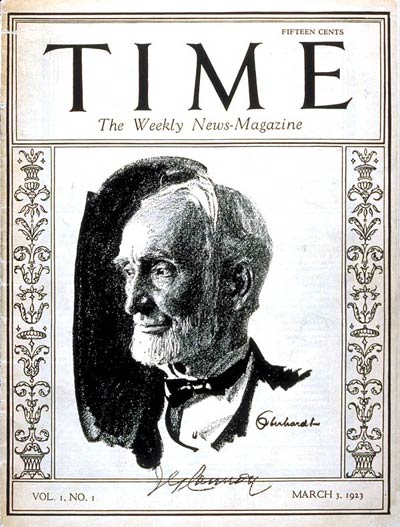
The first issue of Weird Tales went on sale in late February of 1923. It was cover-dated March, but that was a sell-by date. The issue would have arrived in stores on or about February 18, roughly a week before the first issue of Time magazine. In writing about early Weird Tales, I found it useful to think about that kind of context, and to look into that moment in history.
Partly that was because some aspect of a story would occasionally become clear once I understood specific terms or references or background. Mostly, though, I found an immersion in the time helped themes become clearer and habits of thought more obvious. In the hope that exercise might be useful for anyone else reading early Weird Tales or other fiction of the 1920s, I’ll be putting up a series of posts looking at different aspects of the era, reflecting on things I’ve learned or think I’ve learned. I hope these posts will also be useful as references I can link to in my reviews, rather than having to take the time to explain some 1920s-specific detail in a story.
One of the most fun, unique aspects of Goodman Games’ Tales from the Magician’s Skull was the blending of Sword & Sorcery with Dungeon Crawl Classics statistics for the stories. That’s a wonderful recipe that has not been reproduced, despite many super-cool S&S periodicals being available (Dark Moon Quarterly, Battleborn, New Edge S&S, Heroic Fantasy Quarterly, Swords and Sorcery Magazine, Savage Realms, Swords & Sorceries: Tales of Heroic Fantasy, etc. plus loads of anthologies).
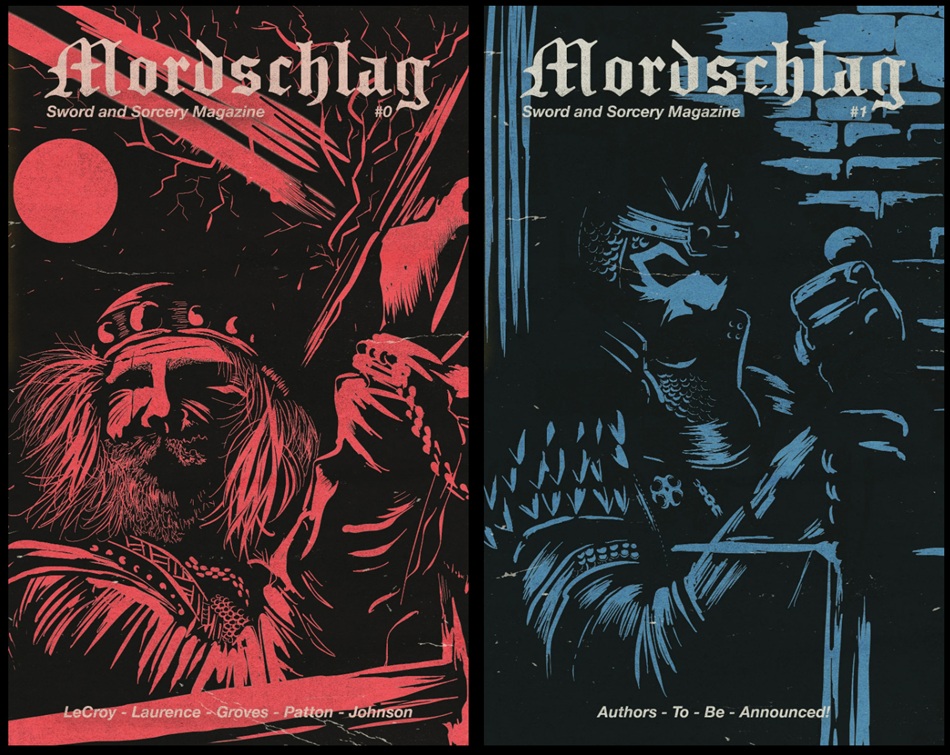
Well, this Dark Muse News post has a Press Release for The Arcanist: Fantasy Publishing’s Backerkit campaign showcasing Mordschlag Magazine!Once again, S&S adventure and RPG gaming are combined. Every pocket-sized issue of Mordschlag promises new short fiction, an article analyzing the genre, and monster stat-blocks pulled straight from the tales and ready-to-play in ShadowDark RPG.
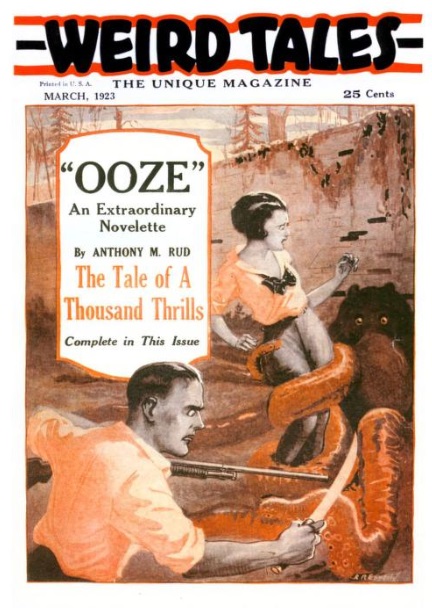
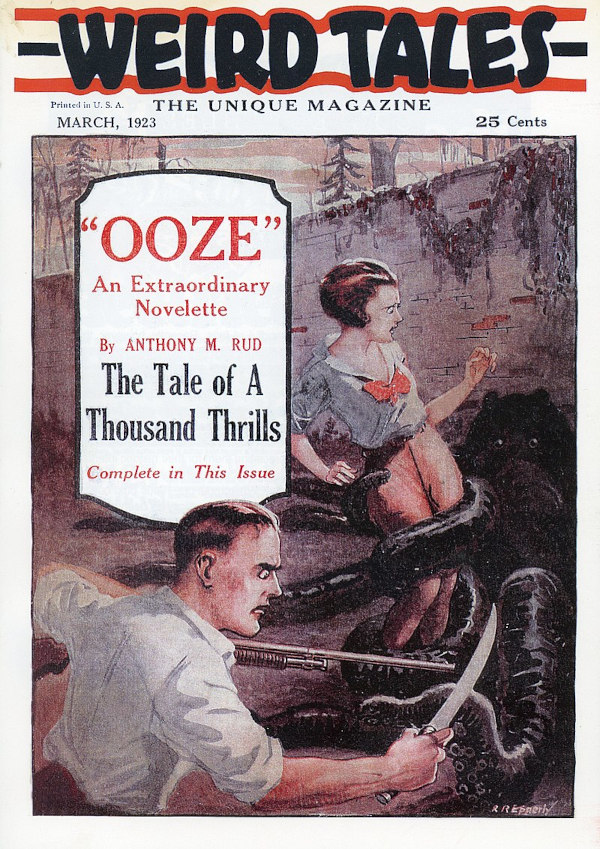
The first issue of Weird Tales landed on newsstands in late February of 1923. 192 pages long, it measured about 6 inches by 9, a standard size for a pulp fiction magazine. There were two different versions of the cover, perhaps due to a printing error; the illustration’s the same, a man with knife and gun fighting a shadowy tentacled monster which has grabbed a nearby young lady, but the colouring’s different. Either way, the cover advertised “‘OOZE’ / An Extraordinary / Novelette / by Anthony M. Rud / The Tale of A / Thousand Thrills.” Perhaps most intriguing, though, was the subhead below the logo: “The Unique Magazine.”
Thanks to modern technology it’s possible for anyone with an internet connection to flip through issue 1 of Weird Tales, if in a virtual format. In a later post I’ll write about the fiction the issue holds, but today I want to consider the magazine as an object (to the extent that’s possible working from a PDF). What do we see as we page through it? What signs of its times stand out? And what can be deduced about the editorial team’s vision?