Browsed by
Category: Editor’s Blog

The blog posts of Black Gate Managing Editor Howard Andrew Jones and Editor John O’Neill

New Treasures: Epic, Edited by John Joseph Adams

New Treasures: Epic, Edited by John Joseph Adams

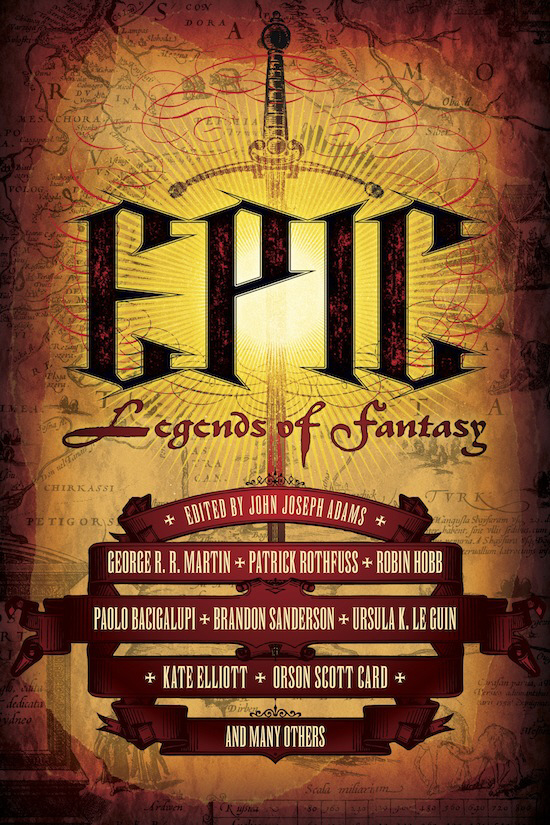
John Joseph Adams EpicBlack Gate‘s Managing Editor Howard Andrew Jones said something in his Monday post on Heroic Fantasy Quarterly 15 that I wish I’d said. So I’m going to repeat it here word for word, and pretend I’m saying it now.

I always wished I could find a way to draw more attention to the Flashing Swords e-zine when I helmed it. Well, it’s gone now. But HFQ is alive and well, and doing good work. So I’m using the mighty bandwidth now possessed by Black Gate online to point you to the e-zine. I can personally vouch for the stories I’ve named above. If you’re a fan of sword-and-sorcery and heroic fiction, you owe it to yourself to check them out. Go there, celebrate the stories, and the writers, and the market, because markets are fragile things and should be cherished while we have them.

Hear hear! We’re always happy when we can point you to a neglected vintage paperback or forgotten silent film. But our greatest pride comes from finding and promoting exciting, vibrant creators doing great work now, who need and deserve your support.

Lately, I feel that way about John Joseph Adams, who’s edited some of the most celebrated anthologies of the past few years — including The Way of the Wizard, Wastelands, Federations, Lightspeed: Year One, The Mad Scientist’s Guide to World Domination, and many others. But his most recent publication of keen interest to heroic fantasy fans is the monumental Epic, a massive collection of some of the finest epic fantasy from the last five decades. It’s a fabulous collection of many of your favorite writers — including Patrick Rothfuss, George R. R. Martin, Tad Williams, Robin Hobb, Ursula K. Le Guin, and Michael Moorcock — alongside exciting authors you should be reading, such as Aliette de Bodard, Mary Robinette Kowal, N. K. Jemisin, Paolo Bacigalupi, and many others.

The complete table of contents is here. Support John Joseph Adams and Tachyon Publications, and keep them publishing groundbreaking anthologies for the next 20 years.

Epic: Legends of Fantasy was published on October 5th by Tachyon Publications. It is 624 pages in trade paperback for $17.95 ($9.99 for the digital version). Complete details at the Tachyon website.

Final Ballot for the 2012 Bram Stoker Awards Announced

Final Ballot for the 2012 Bram Stoker Awards Announced

Cool Bram Stoker trophyThe Horror Writers Association has announced the Final Ballot for the 2012 Bram Stoker Awards. This is the 26th annual ballot; the HWA has been giving out Stoker Awards since 1987.

The award, a miniature haunted house designed by Harlan Ellison and sculptor Steven Kirk, is the coolest trophy in the genre.  Just check it out at right. The little door even opens! If anybody has one of these and they want to unload it, I’m here to help. Seriously. I’m your guy.

Ten more are going to be awarded at the Bram Stoker Awards Banquet in New Orleans on June 15. Let’s get to the nominees.

SUPERIOR ACHIEVEMENT IN A NOVEL

  • Ethridge, Benjamin Kane – Bottled Abyss (Redrum Horror)
  • Everson, John – NightWhere (Samhain Publishing)
  • Kiernan, Caitlin R. – The Drowning Girl (Roc)
  • Little, Bentley – The Haunted (Signet)
  • McKinney, Joe – Inheritance (Evil Jester Press)

SUPERIOR ACHIEVEMENT IN A FIRST NOVEL

  • Boccacino, Michael – Charlotte Markham and the House of Darkling (William Morrow)
  • Coates, Deborah – Wide Open (Tor Books)
  • Day, Charles – The Legend of the Pumpkin Thief (Noble YA Publishers LLC)
  • Dudar, Peter – A Requiem for Dead Flies (Nightscape Press)
  • Gropp, Richard – Bad Glass (Ballantine/Del Rey)
  • Soares, L.L. – Life Rage (Nightscape Press)

Read More Read More

The Real Argo: The Lord of Light Film and the Lost Jack Kirby Sketches

The Real Argo: The Lord of Light Film and the Lost Jack Kirby Sketches

Kirby-Lord-of-LightI was pleased to see Ben Affleck’s Argo win the Academy Award for Best Picture last night. It was the best film I saw last year, although I admit I didn’t see all the nominees.

But I was a little annoyed during parts — especially scenes which included dialog from the fake movie, Argo. It’s clear that Affleck (and his characters) have little respect for science fiction, as the script and its source material are portrayed as utterly terrible sci-fi at its pretentious worst.

Which was particuarly annoying because the source material in question — the script used by real-life CIA agent Tony Mendez, the man portrayed by Affleck — is based on my all-time favorite SF novel, Roger Zelazny’s brilliant Lord of Light. The man who wrote the original Wired article that inspired Argo, Joshua Bearman, explains it this way:

Argo was the name Tony gave to a script that was in turnaround and sitting in a pile at [makeup artist John] Chambers’ house. That script was called Lord of Light and had been adapted from a successful Roger Zelazny science-fantasy novel of the same name. A small-time self-starting dreamer… named Barry Geller had optioned Zelazny’s book himself and raised money to get the project started. He hired Jack Kirby to do concept art and Chambers to make the alien masks. But the whole project fell apart…

It was hard to see the script for Lord of Light merciliessly skewered for laughs in Argo. Still, something good has come out of it all. As a result of the recent spotlight on the film, Jack Kirby’s original sketches — thought lost for years — have come to light.

BuzzFeed has reproduced eleven of the sketches in an article by Richard Rushfield. If you’re a Kirby fan, or a fan of Zelazny’s SF masterpiece, they are well worth a look. Check them out here.

New Treasures: The Unearthed Arcana 1st Edition Premium Reprint

New Treasures: The Unearthed Arcana 1st Edition Premium Reprint

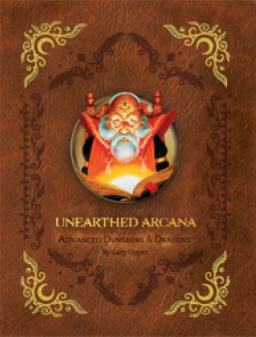
unearthed arcanaThe Premium 1st Edition Advanced Dungeons & Dragons reprint series is one of the best ideas Wizards of the Coast has ever had.

By bringing Gary Gygax’s original AD&D rulebooks back into print in deluxe editions, Wizards is making the groundbreaking work of the father of role playing available to a modern audience. More than that, it’s a tacit acknowledgement of the growing popularity of retro-gaming, a nod to those players who still enjoy playing first edition (or OE, Original Edition) D&D and AD&D.

I’m one of them. My most recent game of D&D was last Sunday, and one of the books we reached for during play — as a troop of goblins chased my player characters through a dark wood — was the first edition AD&D volume Unearthed Arcana.

Unlike the Players Handbook, Monster Manual, and Dungeon Masters Guide, Gygax’s Unearthed Arcana — which, among many other innovations, introduced the Cavalier, Barbarian, and Thief-Acrobat classes — had never been reprinted, and the copy we used to quickly check the effects of my daughter’s druid’s “Goodberry” spell was the original TSR printing from 1985. That’s a hard book to come across these days, as one of my young players lamented.

But no longer. Wizards of the Coast released the Unearthed Arcana 1st Edition Premium Reprint on Tuesday of this week. Best of all, this edition incorporates the corrections and updates published under Gygax’s supervision in Dragon magazine, making this the definitive edition of the text. At long last, players can assemble a complete collection of the most essential rule books for the greatest role playing game ever written, without having to pay collector’s prices for long out-of-print volumes.

The Unearthed Arcana 1st Edition Premium Reprint was published by Wizards of the Coast on February 19, 2013. It is 128 pages in hardcover, priced at $49.95. There is no digital or softcover edition.

Congratulations to Black Gate on 3,000 Blog Posts!

Congratulations to Black Gate on 3,000 Blog Posts!

3000I feel like one of the service staff at a restaurant, waiting excitedly at the entrance for their 10,000th customer. Minus the cool food service uniform.

Ryan Harvey’s article on Edgar Rice Burroughs’ The Oakdale Affair, which went live less than an hour ago, was our 3,000th post. Congratulations to Ryan — and indeed, to the entire Black Gate staff.

The Black Gate blog was the brainchild of Howard Andrew Jones, who suggested I replace the outdated site he and I updated haphazardly with a modern WordPress web publication. I originally said no — and in fact said ‘No” the next half dozen times Howard brought it up. But he eventually talked me into it. Our new look was designed by Leo Grin and our first two posts, in November 2008, were both written by our site engineer David Munger. Our first regular bloggers were David Soyka, Judith Berman, E.E. Knight, Ryan Harvey, James Enge, Scott Oden, and Bill Ward.

Note that I was not a regular blogger. I was not a blogger at all. It took me six months just to figure out how to log in and puzzle out WordPress — and much longer before I dared make my first, timid post. I wrote over 750 in the next four years, and gradually got the hang of it.

We are very proud to be able to bring you, our readers, the best in new and overlooked fantasy every week. The site has grown by leaps and bounds in the last four and a half years, and today a team of nearly 30 bloggers contributes over 20 articles per week. In November 2008 our readership was in the hundreds; this month we are perilously close to breaking 100,000 visits. It’s been an honor and a privilege, and we’re pleased to have you here to celebrate with us.

More Bad News for ‘Zines: Reader’s Digest Files For Bankruptcy

More Bad News for ‘Zines: Reader’s Digest Files For Bankruptcy

READERS-DIGEST March 2013Reader’s Digest, the most widely-purchased magazine in the world, has filed for bankruptcy protection for a second time.

Reader’s Digest was founded in 1922; it is currently published in more than 70 countries, with 49 editions in 21 languages. Not long ago, it had a worldwide circulation of over 10 million copies per month, making it the largest paid circulation magazine on the planet.

The magazine emerged from bankruptcy in 2009, selling off assets to lower its debt — including cooking website Allrecipes.com (sold for $180 million) and sister magazine Every Day With Rachael Ray (for $4.3 million). Its paid circulation fell to 5.5 million at the end of 2012, making it the fifth-biggest consumer magazine by circulation in the U.S., behind two publications from the AARP, Game Informer Magazine, and Better Homes and Gardens.

The magazine filed for Chapter 11 protection in an attempt to cut debt; it is hoping to convert about $465 million of debt into equity held by its creditors. Reader’s Digest has about $1.1 billion in assets and slightly under $1.2 billion in debt, and has arranged roughly $105 million to keep it afloat during bankruptcy proceedings.

The news follows a lengthy obituary list for magazines in 2012, including the 80-year old Newsweek, which published its last print issue in December, music magazine Spin, Nintendo Power, Whole Living, American Artist, and many others. Fantasy fans lost the print version of the excellent New York Review of Science Fiction in 2012, which converted to digital format last spring.

The Rise of the Short Story: The New York Times on the New Era of Short Fiction

The Rise of the Short Story: The New York Times on the New Era of Short Fiction

The New York Times logoInteresting post on the success of short stories in the digital marketplace at today’s New York Times:

The Internet may be disrupting much of the book industry, but for short-story writers it has been a good thing. Story collections, an often underappreciated literary cousin of novels, are experiencing a resurgence, driven by a proliferation of digital options that offer not only new creative opportunities but exposure and revenue as well.

Already, 2013 has yielded an unusually rich crop of short-story collections, including George Saunders’s Tenth of December, which arrived in January with a media splash normally reserved for Hollywood movies and moved quickly onto the best-seller lists…

“It is the culmination of a trend we have seen building for five years,” said Cal Morgan, the editorial director of Harper Perennial Originals, who until last year ran a blog called Fifty-Two Stories, devoted to short fiction. “The Internet has made people a lot more open to reading story forms that are different from the novel, and you see a generation of writers very engaged in experimentation.”

The article was written by Leslie Kaufman; the complete text is here.

Renovating Tegel Manor

Renovating Tegel Manor

Tegel Manor-smallWhile I was assembling my Judges Guild article on Tuesday, I stumbled on an odd reference to a revised version of one of their earliest (and most famous) products: Tegel Manor. I’d never seen a copy however, and was pretty sure it didn’t exist, so I set it aside to investigate later.

What makes Tegel Manor so famous? I don’t think I could articulate its wonders as well as the talented James Maliszewski, author of the Grognardia blog; here he is:

Tegel Manor is without a doubt one of Bob Bledsaw’s masterpieces. Describing a sprawling 240-room haunted castle, the module is a textbook example of a funhouse dungeon, utterly lacking in anything resembling an ecology and filled with many encounters for which the adjective “whimsical” is charitable at best. The contents and/or inhabitants of each room are random — in some cases literally — meaning that, here you might find nothing more threatening than some giant beetles but next door you might find a Type III demon polymorphed as a kindly old beggar…

With its random encounter charts containing 100 members of the cursed and unfortunately named Rump family (all of whose names start with the letter R) and its goofy encounters (“Four Zombies … bowing to a Giant White Rat … in a pink cape and red plumed hat”), it certainly seems that way. It’s one thing to sidestep naturalism, but Tegel Manor goes above and beyond the call of duty when it comes to “gonzo.”

But the map is a thing of beauty. Nothing — and I mean nothing — has ever beaten it… It’s filled with winding passages, secret doors, mazes, empty rooms, weird features, and more.

James’s complete review is here. Tegel Manor was originally released in 1977, and revised and expanded in later editions. A little digging revealed that Necromancer Games had contracted to do an updated version for the Old School Renaissance market — and even produced the cover at right — but Judges Guild withdrew the rights before it saw the light of day. But that’s a story that deserves a post of its own.

Did Entertainment Weekly Reveal that Benedict Cumberbatch is Playing Khan?

Did Entertainment Weekly Reveal that Benedict Cumberbatch is Playing Khan?

Entertainment Weekly Star TrekIn a sharp-eyed bit of investigative reporting, Tor.com has reproduced screenshots from the Entertainment Weekly Back Issues store that name the villain in the upcoming J.J. Abrams film Star Trek Into Darkness as Khan.

As we reported back in December, speculation has been rampant around just whom Benedict Cumberbatch will be playing in the new film. IMDB originally listed his character as Gary Mitchell, the Enterprise officer who becomes an all-powerful psychic loonie in one of the show’s earliest and best episodes, “Where No Man Has Gone Before.” Rumors that he was playing Khan, the genetically-engineered supervillain originally portrayed by Ricardo Montalban in the episode “Space Seed” and the film Star Trek II: The Wrath of Khan, eventually led the otherwise tight-lipped Cumberbatch to deny it.

As shown by Tor.com however, screen captures for the February 15 cover-dated issue of Entertainment Weekly allow you to select one of two covers, the “Spock & Kirk” cover, or the “Kirk & Khan” version.

EW hastily deleted the notations, and the latest version of the page gives no such identifiers.

In its current cast list, IMBD now lists Cumberbatch as playing “Khan (rumored),” and Alice Eve as playing Dr. Carol Marcus, Kirk’s ex-flame and baby mama from Star Trek II.

The latest Super Bowl TV trailer for the film has been posted on YouTube. Star Trek Into Darkness is directed by J. J. Abrams, and is set for release on May 17, 2013. As we reported in January, Abrams was also selected as the director for the next Star Wars film.

Meanwhile, there’s no truth to the rumor floating in fan circles that J.J. Abrams will also be tapped as the new pope.

New Treasures: Wilderlands of High Fantasy

New Treasures: Wilderlands of High Fantasy

Wilderlands of High FantasyIn the very early days of adventure gaming, there were two companies you could count on: TSR, creator of Dungeons and Dragons, and Judges Guild.

Judges Guild was admittedly second tier. While TSR was constantly innovating, with full color cover art and high production values, Judges Guild saw no reason to deviate from the look they established in 1976: rudimentary layout and typesetting, and two-color covers that looked torn from a coloring book.

But they were prolific. My weekly pilgrimages to the gaming store in 1979 rarely yielded a new TSR release — they were few and far between — but Judges Guild never let me down, and I went home satisfied with many a JG product tucked under my arm. At their peak in the early 80s, they employed 42 people and had over 250 products in print, an astounding output.

Judges Guild was founded by Bob Bledsaw and Bill Owen; their first major product (and claim to fame) was the City State of the Invincible Overlord. The ambitious setting for the City State — a massive 18 maps covering nine continents drawn from Bledsaw’s home campaign, ultimately used as the locale for numerous adventure modules — became their next major release: The Wilderlands of High Fantasy, the first licensed D&D product and the first true campaign setting for the game.

Wilderlands was different in other ways, too. Perhaps most importantly it had a true sandbox feel, rather than the tightly-focused adventures of Gygax and Co, in which players were expected to follow a linear path. It encouraged a wide-open style of gaming, focused on exploring vast and wondrous forests and rugged landscapes, rather than dungeon crawls.

Read More Read More