Almost Gothic: The Nine Tailors by Dorothy Sayers
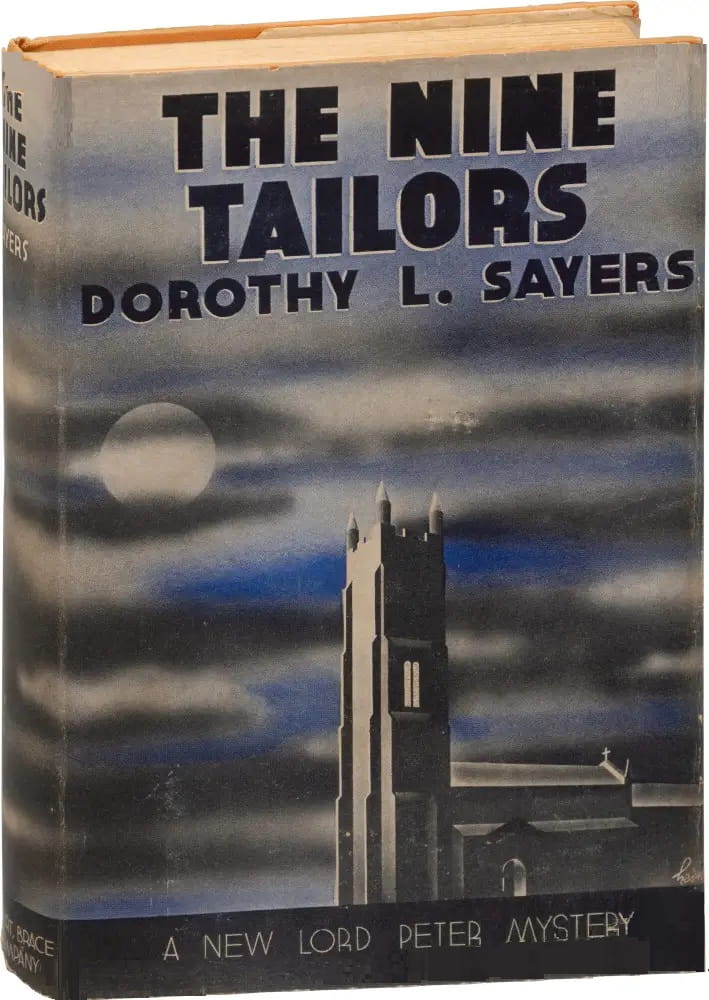
The Nine Tailors has been described as the best of Dorothy Sayers’s novels. It certainly has many of the features of classic literary fiction, including a small rural community as a setting; a cast of characters from every level of society; and elaborate symbolism focused on a set of church bells, each with a meaningful name. Indeed the entire novel seems to have a symbolic level of meaning over and above the literal plot of the mystery. Of course mystery novels nearly all begin in medias res, with the discovery of a death, after which the detective reconstructs the previous events; but this novel’s backstory reaches back roughly two decades, to the Great War, and includes much more than the death.
The title The Nine Tailors alludes to the old saying “Nine tailors make a man.” This is sometimes taken as a slur on tailors as cowards or weaklings, saying that one real man is worth nine of them; but Sayers has in mind a custom of ringing nine strokes of a church bell for a man’s death, six for a woman’s, or three for a child’s. There are several deaths in the course of the novel.
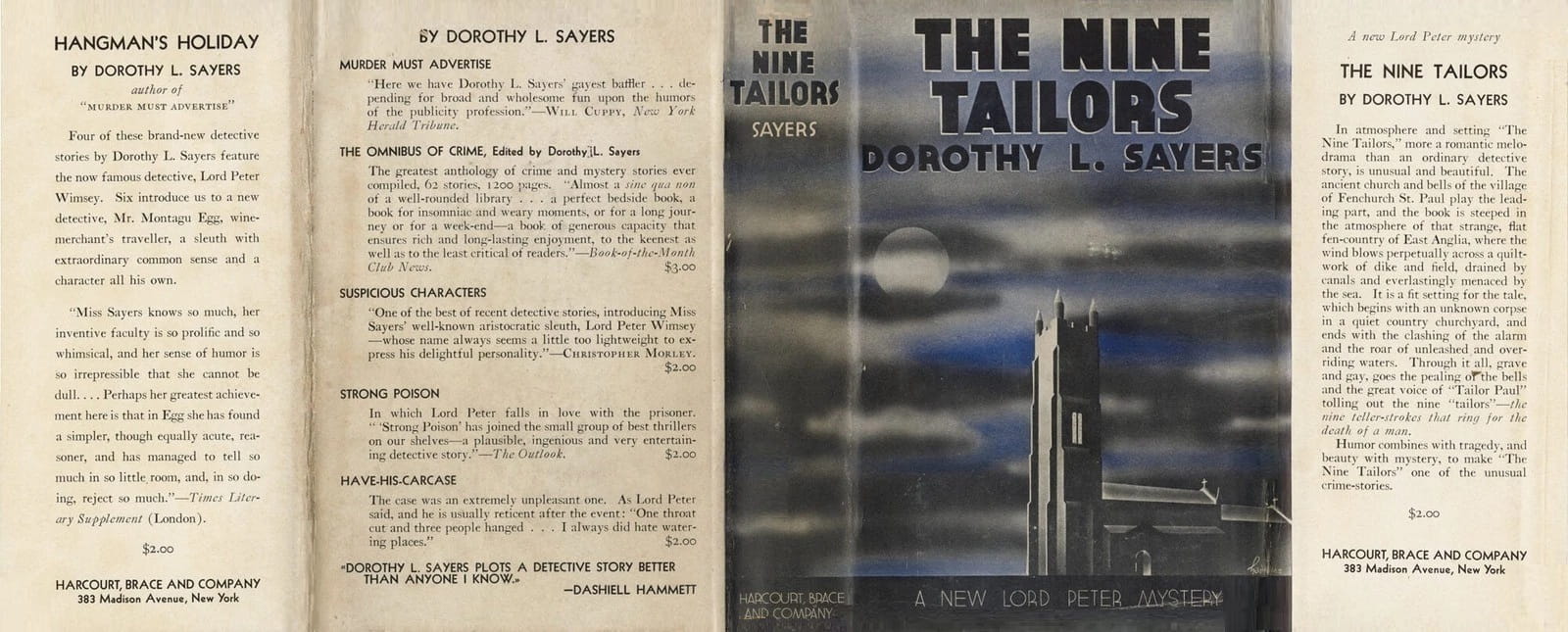
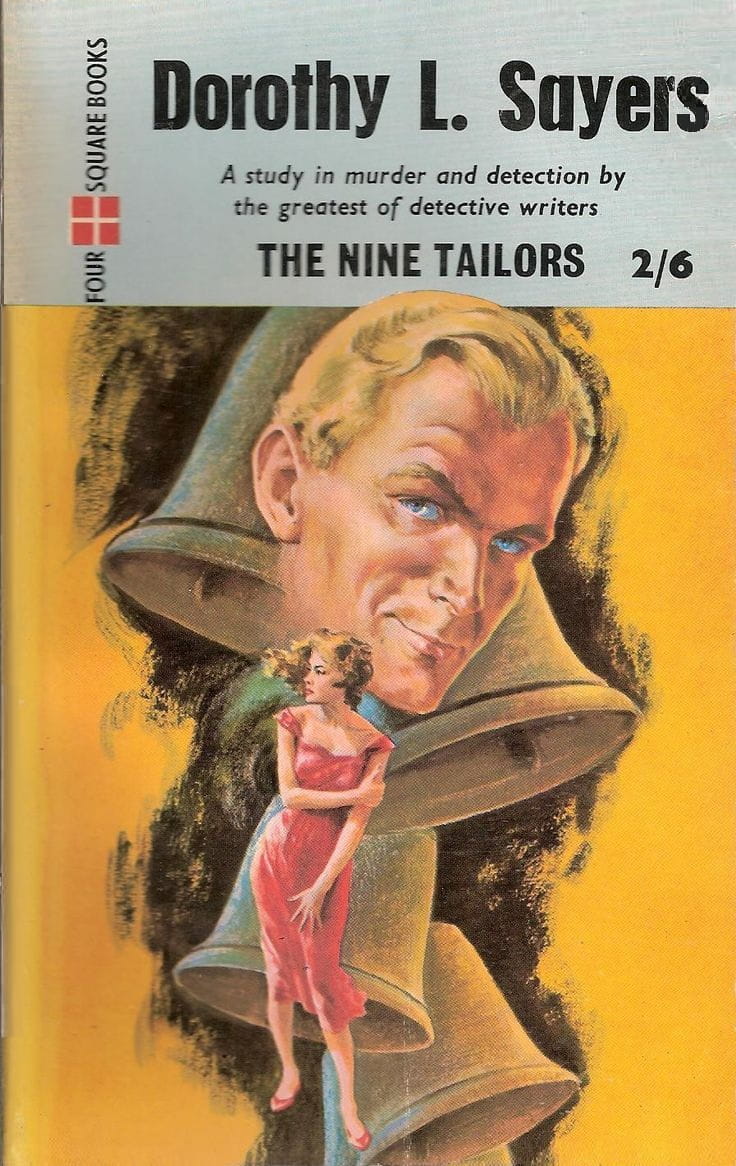
[Click the images to tailor larger sizes.]
However, the opening section of the book seems to have nothing to do with death. Lord Peter Wimsey and his manservant Bunter, traveling in the fen country some distance north of London, run off the road in the fog. They find their way to the nearby village of Fenchurch St. Paul, where the rector, Theodore Venables, offers to put them up overnight at the parsonage. In conversation, it emerges that Venables is devoted to the art of change ringing, and has plans to observe New Year’s Eve by a prolonged ringing of a specific pattern—which are interrupted when he learns that one of his eight ringers is in bed with a severe case of influenza.
However, Wimsey has acknowledged having practiced change ringing at one time (one more of an amazing list of accomplishments!) and cannot resist Venables’s plea for help. So after a short nap (insisted on by Mrs. Venables) and supper, he ends up staying up all night pulling the rope for his bell, Sabaoth. Then in the morning Venables is called away to give last rites to Lady Thorpe, one of the leading family of the village, and shortly after the bell is tolled for her death. Wimsey hears the story of how the family fell on hard times years ago when a guest’s uninsured emerald necklace was stolen, and Henry Thorpe (now Sir Henry), insisted on paying her for the loss.
Then his car is set to rights and he departs, with a brief encounter on the way out with a bearded man whom he classifies as an old lag (a man released from prison). All of this is very characteristic of Wimsey and does an elegant job of exposition, but it’s unusual for a mystery to start out with 66 pages without a suspicious death!
In the next part, Sayers introduces another important character: Hilary Thorpe, Sir Henry’s daughter. She’s fifteen years old, “tall and thin and rather gawky,” but Sayers does a skillful job of making her interesting and even appealing without physical beauty—she has red hair, she aspires to go to Oxford and become a novelist (and has a keen eye for details), and she enjoys climbing the bell tower and looking out from 120 feet up, with neither fear nor dizziness.
 |
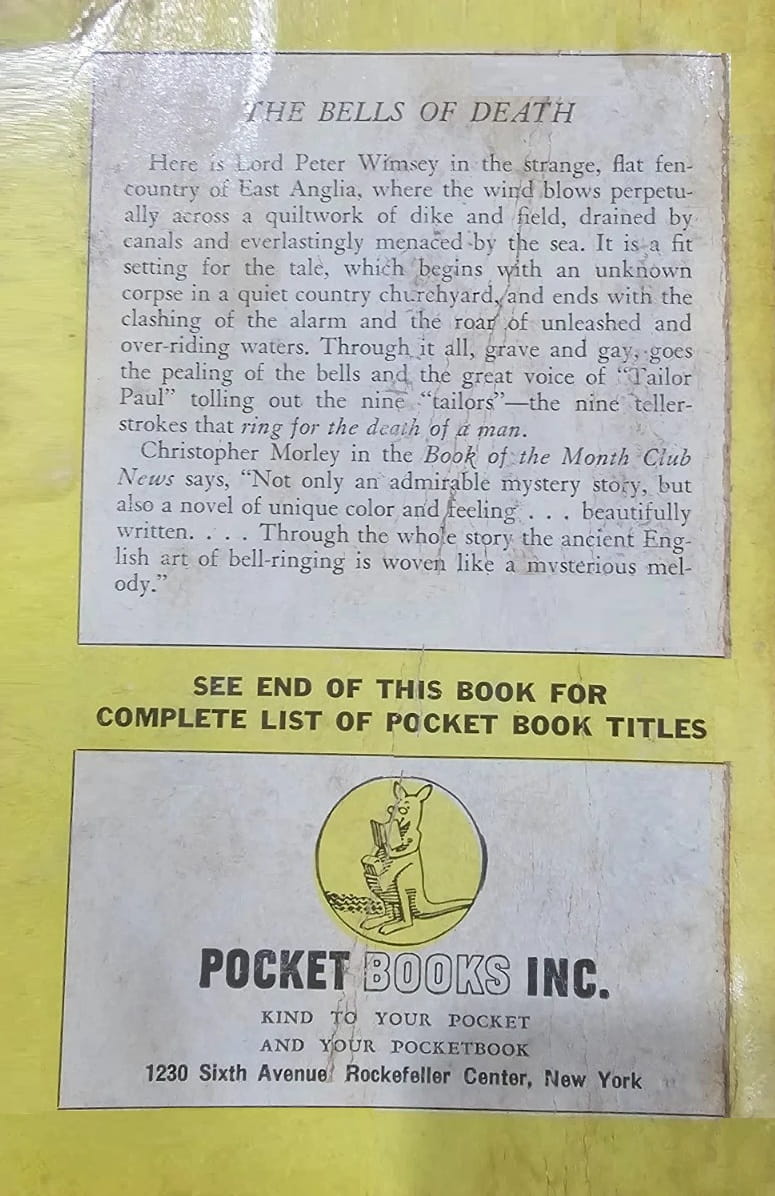 |
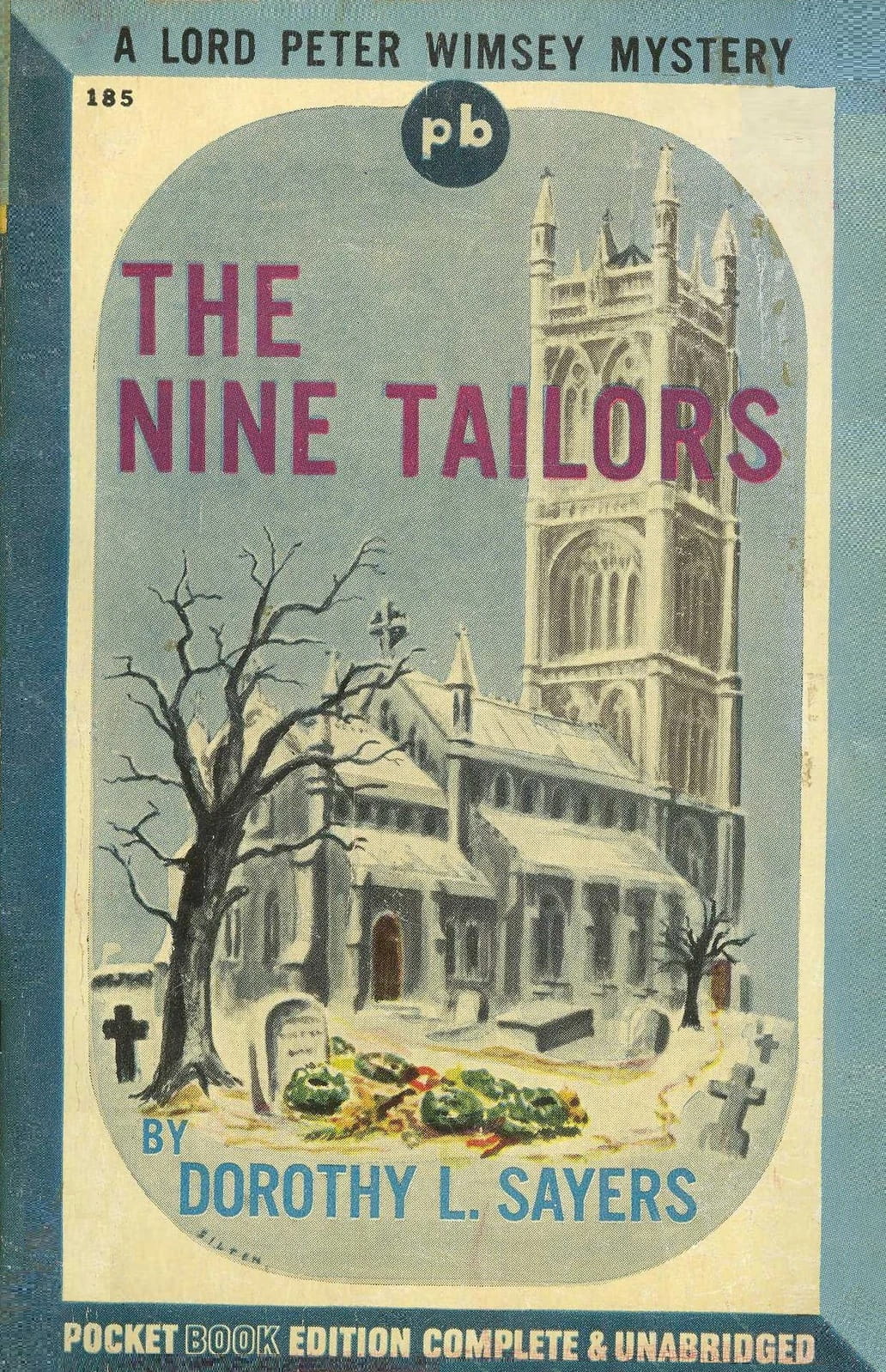
The Nine Tailors by Dorothy L. Sayers (Pocket Books, 1942)
While up there, she finds a piece of paper on which is written a surreal paragraph about elven elephants and minstrels. Hilary is worried about her father (an invalid since the Great War), and shortly after a visiting specialist tells her, “I can’t disguise from you that your father’s condition is serious, but Nature has marvelous powers of recuperation”—which, Sayers comments wryly, is “the medical man’s way of saying that… you may as well order the coffin” (without, though, any thought of telling the truth about the patient’s condition!).
Six days later, Sir Henry has died, and is to be buried next to his wife. But in digging up the grave again, the sexton finds an extra corpse — the remains of a man, with his hands cut off and his face beaten in, making him unidentifiable, but no one is missing locally. The police are called in, and Venables writes to Wimsey, who shows up quickly, delighted with something better to occupy his time than social engagements.
 |
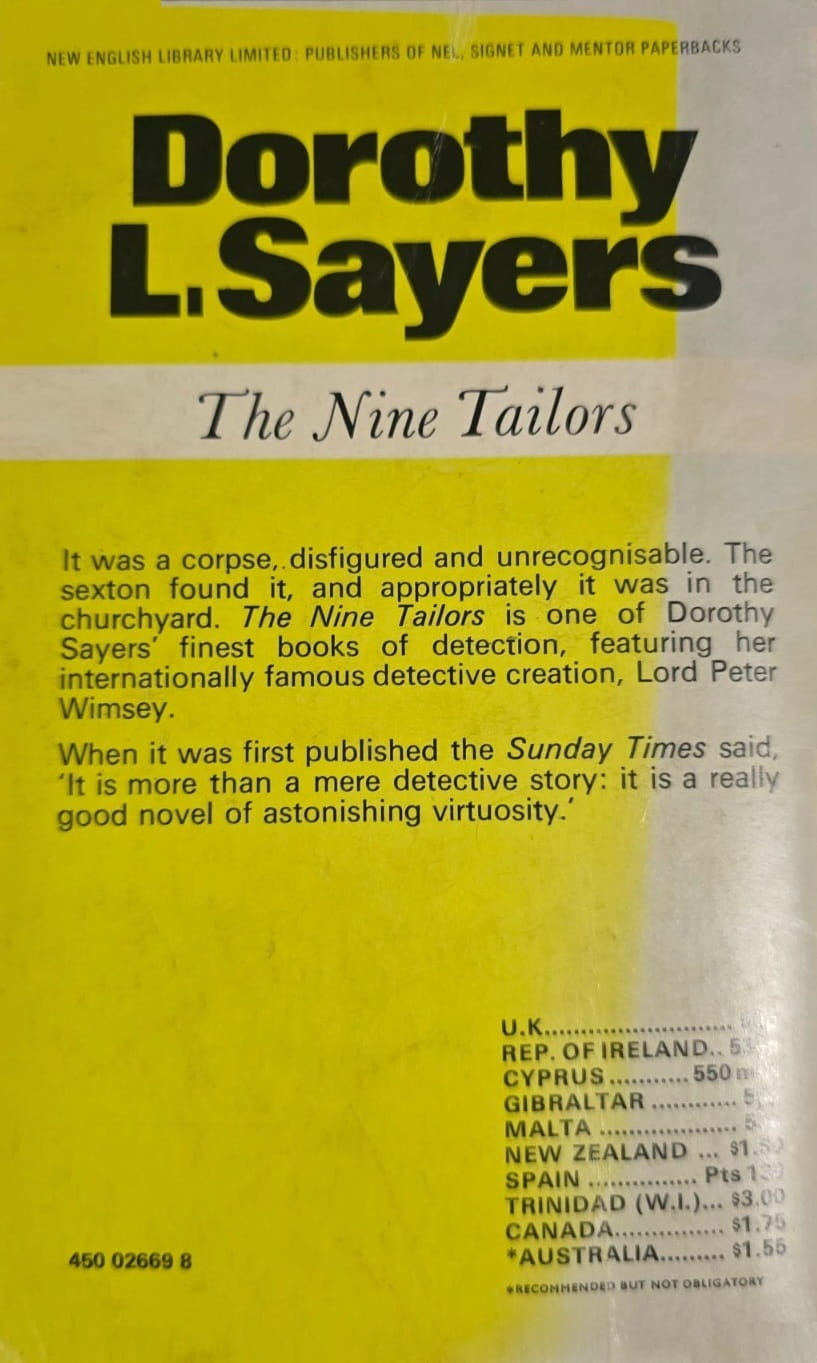 |
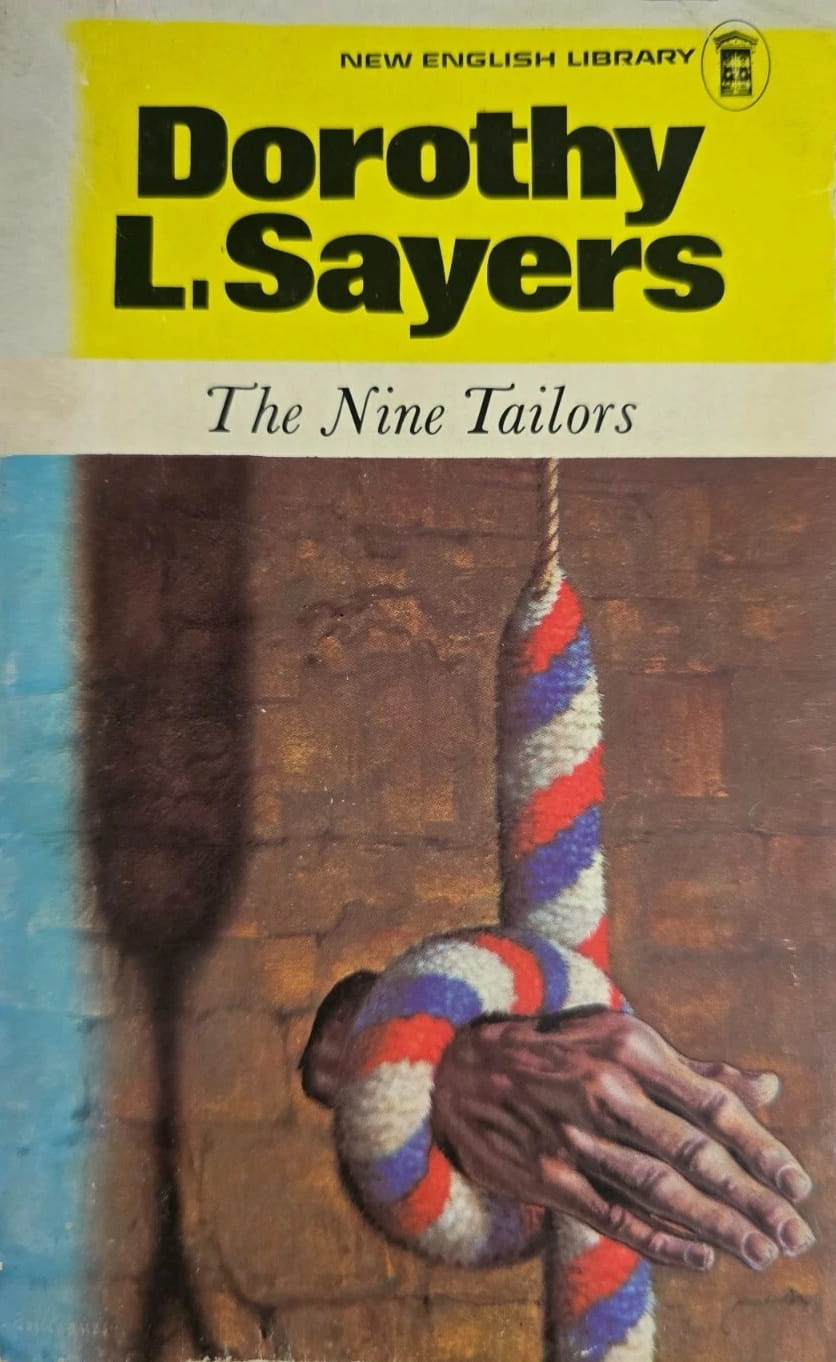
The Nine Tailors by Dorothy L. Sayers (New English Library, November 1968)
The result is a complicated mystery. There is the question of how the unidentified dead man came to die; an autopsy rules out several causes of death and doesn’t suggest one. There is the question of the man’s identity; Wimsey and various police officers follow three different trails to try to work it out, suspecting several different men of being the nameless corpse.
One of the possible identities is that of a well-known thief with pretensions to being high-class, who was involved in the theft of the emeralds. A local farmer and his wife, Will and Mary Thoday, seem to know something about the case, but are trying to hide whatever it is they know. And there’s the mysterious message, which Lord Peter struggles to decode.
The eight church bells play a part in all this, not only by being rung to recognize various deaths, but by some clues being found in the belfry, and by the technique of change ringing being used as a cryptographic key. There’s also a running motif of personalities being attributed to them, and a suggestion that they can punish people who offend them, or even that they manifest the judgment of God.
The effect is almost Gothic, and indeed The Nine Tailors has something of the feel of a Gothic novel. This is enhanced in the final chapters, when a large civil engineering scheme appears to bring about a massive flood. The consequences of the theft of the emerald necklace, twenty years before, also carry forward in something very like a familial curse.
 |
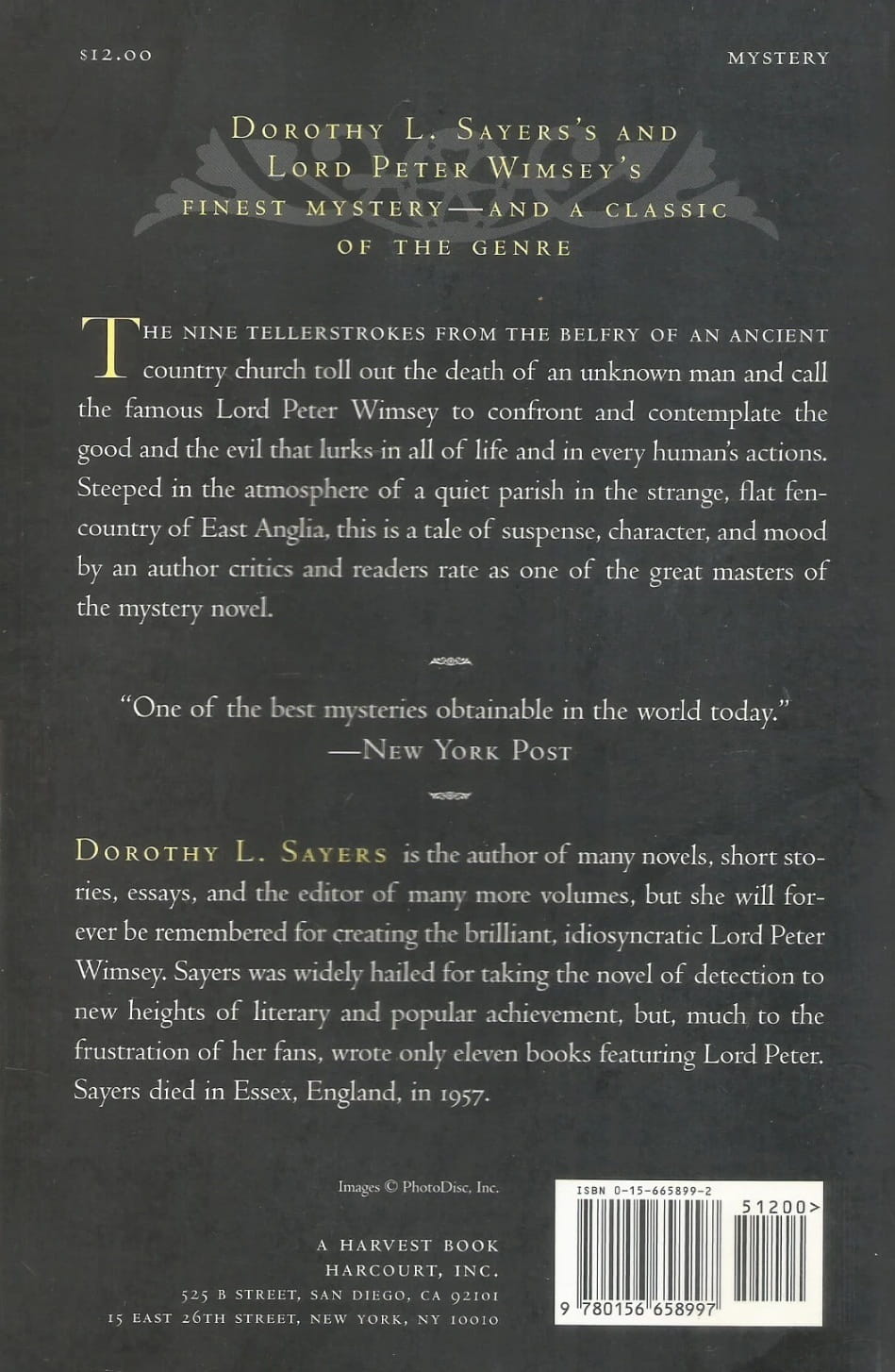 |
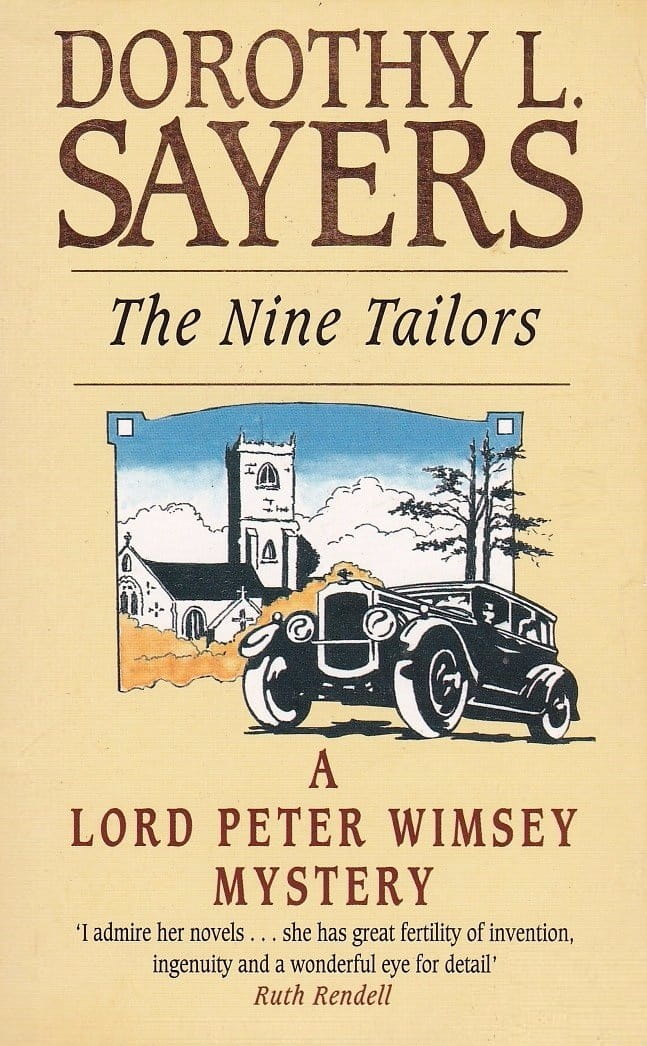
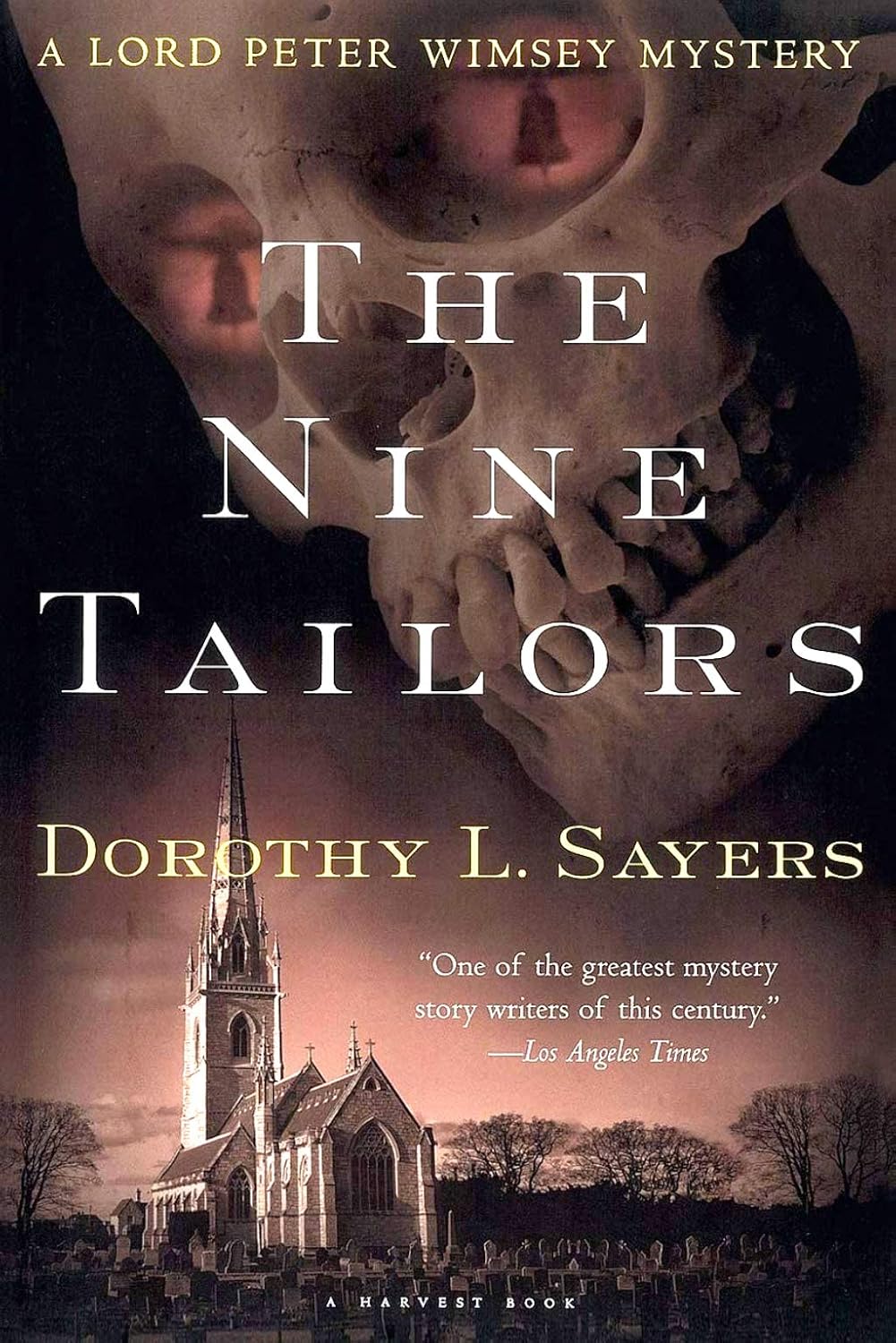
The Nine Tailors by Dorothy L. Sayers (Harvest Books)
Another thread in this complicated story is Wimsey’s meeting and liking Hilary Thorpe. Her father’s death leaves her under the guardianship of an uncle who doesn’t approve of Wimsey and doesn’t think women should have university educations. On the other hand, Wimsey’s ingenuity lets him do something to help her; through his agency, she’s back at Fenchurch St. Paul just in time to help during the flood. And before that, she takes an interest in the mystery and makes some helpful suggestions. There’s no suggestion of a romantic relationship, but Sayers makes the natural sympathy of their minds believable and attractive.
“Providence?” said the old woman. “Don’t yew talk to me about Providence. I’ve had enough of Providence. First he took my husband, and then he took my ‘taters, but there’s One above as’ll teach him to mend his manners, if he don’t look out.”
William H. Stoddard is a professional copy editor specializing in scholarly and scientific publications. As a secondary career, he has written more than two dozen books for Steve Jackson Games, starting in 2000 with GURPS Steampunk. He lives in Lawrence, Kansas with his wife, their cat (a ginger tabby), and a hundred shelf feet of books, including large amounts of science fiction, fantasy, and graphic novels.
I, too, recall The Nine Tailors being acclaimed as the best of the Wimsey books. I remember it being very complicated, beyond my ability to reason out the solution, but still engaging. I doubt that I will ever take up change ringing as a hobby, either, much as I enjoy hearing the local bells chiming on the canonical hours (or so).
(Thank you for taking the time to explain the reference in the title, and the meaning thereof. I was trying to figure out what nine types of clothing a man would need, to fully and properly present himself to the world, until you revealed it to be an insult.)
I’ve been wanting to give Sayer a try. Should I start with “Whose Body?”, or can I start with “The Nine Tailors.”
If you start with Whose Body? you can see the characterization develop from book to book. But you don’t have to do it that way. I started with Murder Must Advertise, and I enjoyed it a lot and became a fan; I suppose you could start with The Nine Tailors.
I do think it’s better not to start with any of the Harriet Vane novels (Strong Poison, Have His Carcass, Gaudy Night, and Busman’s Honeyman); it’s better to get to know Lord Peter by himself before you see him interacting with Harriet. I totally love Gaudy Night, but Lord Peter is really not its protagonist.
I started with The Nine Tailors. Well, actually, I started with the television adaptation of The Nine Tailors, loved it, and went on to the book from there (and the other books and other adaptations from that point). As I recall, the episodes (eight in all) weren’t coming quickly enough for me, so I went to the book to learn how things were going to turn out. (It did not ruin the program for me. The adaptation was that good. Plus, all the Wimseys are comedies of manners as well as mysteries, and can be revisited again and again to enjoy that aspect, regardless of how many trips back to the well you can stand in regard to the mystery.) The Nine Tailors is a great place to start! It’s pretty much a stand-alone, with only Wimsey and Bunter really appearing from the regular cast, and you don’t have to know anything at all about the rest of the series to fully appreciate this one. (There are brief appearances by or references to a few other supporting characters, but blink and you’ll miss them.) The particular cast brought on board for just this novel are fascinating, and all provide the sense of having had full lives well outside the confines of the story. The church, the bells, and the fen country itself are practically fully-realized characters themselves. The mystery is top-notch, and intimately connected with pretty much all the main players, including, surprisingly, Lord Peter himself. Incidentally, I believe the saying about the nine tailors was, in origin, exclusively in references to bell ringing (the word tailor used therein actually MEANS a bell, not a maker of clothing). I suspect it came to be thought as an insult only because people who didn’t understand the saying were looking for one, and only knew the common meaning of “tailor.”
I agree that that sort of folk etymology sounds plausible. Though the idea that tailors are cowardly seems to go back a ways; there’s a nursery rhyme about tailors being afraid of a snail.
BPK: So “tailor” would actually be an alternate spelling or pronunciation of “toller,” in the case of the saying?
Yep! Though actually both tailor and toller, in this usage, are variants of the original word “teller,” with “tell/toll” being the peal of the “teller/toller” (bell).
“ run off the road in the fog”
No, it was snowing so hard they didn’t see the 90 degree turn after going over the bridge, and so drove into the ditch.
I started with the unpleasantness at the bellona club. I think any of the non-Vane books can be a good entry point.