Weird Times 3: Fashion
This post is the third in a series reflecting on the world of 1923, and the 1920s generally, as a background to early issues of Weird Tales. Imagine that you’re an American in 1923, and you’re taking a walk to the newsstand to buy the first issue of a new pulp fiction magazine. What sort of things will you see?
Walk down a city street and you’ll observe other people around you, meaning you’ll see the fashions of the time. Any given era has its characteristic clothes and hairstyles, and the nineteen-twenties are no exception. Interesting to me personally are the reasons behind the adoption of specific fashions, and what they have to say about the way the world is changing. I’m writing these background posts as though one aspect of the 1920s can be divided from the others, but the truth is that then as now everything’s mashed together. Fashion’s affected by technology and politics, by ideas about formality and ideas about sexuality; and it can create images that will, for later years, define its moment.
(Some disclaimers before we go further: I am neither American nor a historian, though I’ve written pop history in the past. These posts are reflections on things I’ve read about the 1920s, and things I’ve come to think about the time; things I find interesting, and things I think underlie the fiction in Weird Tales. If I repeat here things that are common knowledge among Americans, my apologies; I can only say they seemed relevant to me as a foreigner.)
There is an awful lot to be said about fashion in the 1920s, and I am one of the least qualified people on Earth to talk about fashion generally. Still, through diligent research I’ve found a few things I think are worth observing.
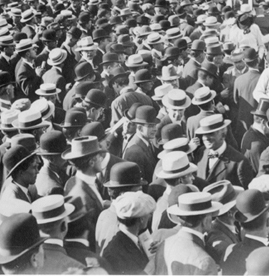
Let’s start with masculine fashions. Men usually have hair longer on top and shorter at the sides, combed back or parted in the centre or side, with no sideburns and little facial hair beyond a slim moustache; they often wear their hair slicked back, the easier to wear hats. When outdoors men wear hats — top hats for special occasions, at other times flat caps, maybe, or maybe fedoras, (edit, see comments) sometimes called similar to trilbys, and called “swagger hats” when the brim was turned down at front and back. Walking to the newsstand to buy the first issue of Weird Tales, it’s February; but in warmer months you’ll see straw boaters and Panama hats, as well as flat caps; many cities have a ‘straw hat day’ in early summer after which one only wore straw hats, then a ‘felt hat day’ on September 15. Per the foregoing link (more here): “In 1922’s New York City a “hat smashing orgy” took place a few days before the 15th, where gangs of hoodlums robbed men of their straw hats, smashing, trampling and beating up any man who resisted.” Hats were expected masculine garb. In a story in the 1919 magazine The Thrill Book (“The Borderland Bridge,” by Charles T. Jordan, in the June 15 issue, volume 1 number 8) a man spots “a raving maniac” outside a window and climbs out the aforesaid window to go after him; the next sentence, starting a new paragraph, begins: “Hatless, but unconscious of it, he made his way through the dark to the graveled walk.”
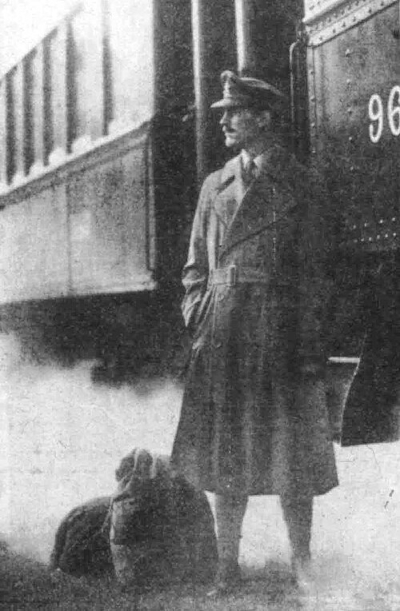
The Great War affected male fashion in a number of ways. Men are now wearing wristwatches, which for most of the 19th century were primarily worn by women; men took up the habit when watches, some with glowing radium numbers, were issued to soldiers in the War. Similarly, after disposable razors, invented by King Camp Gillette in the 1880s, were issued to troops as part of their standard field kit, men grew used to shaving themselves instead of going to a barber (over the last decade or so, Gillette has also pushed a campaign to encourage women to shave not only unwanted facial hair but also previously-innocuous underarm hair; other companies are now, so far with mixed success, encouraging women to remove leg hair, linking hairlessness of the body with femininity). And the U.S. Army was an early adopter of what we now call the zipper; it is in 1923 that the B.F. Goodrich Company will introduce a new kind of galoshes with fasteners that you use to “zip ’er up.” Perhaps the male fashion trend fostered by the War that is most directly relevant to the pulps is the trench coat; invented for British officers just before the War, using new fabrics both lightweight and waterproof, the trench coat became popular with American soldiers when the United States entered the conflict and has remained a popular item in the years since.
Male dress has been getting generally less formal since the War, incorporating softer fabrics, including new synthetic materials like rayon. Trousers have lower waistbands, a style similar to uniform trousers, meaning that belts are replacing suspenders. Suit jackets are common, but fashion’s generally tending to the casual — sweatshirts, baggy pants, even sportswear like plus four breeches. Suits and ties are still required on formal occasions, and one particular style of formal wear has spread over the last couple of decades since it was introduced in America in the New York village of Tuxedo Park, from which said formal wear took its name. On the other hand, walking along a winter street you might see men in raccoon coats (there’ll be a fad for the things in 1928).
Women’s clothes have recently changed in a number of ways, starting with how they’re made. At the start of the twentieth century it was common for women to make many of their and their families’ clothes in their own home. That’s changed, partly due to the spread of mail-order companies and department stores, and partly due to a large immigrant population, including tailors, seamstresses, and a labour pool working in sweatshops. It is in this context that we see an ad for a mail-order dress in the first issue of Weird Tales.
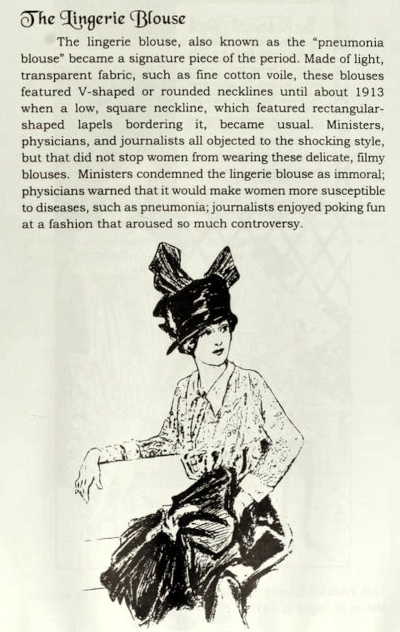
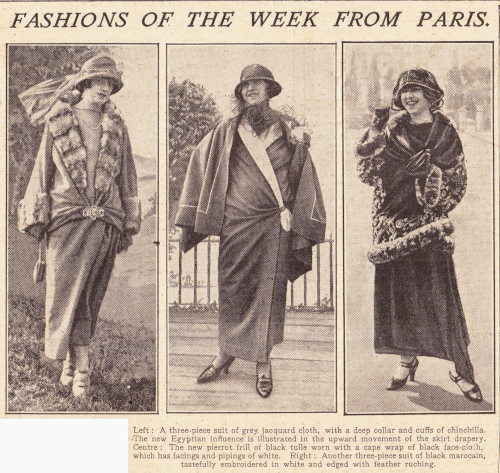
Women’s fashions reflect a new sense of freedom. In many ways; there are cases on record from before the Great War of women being arrested for not wearing a corset, while in 1923 corsets are being abandoned. But also the amount of fabric in dresses is dropping. In 1913 the average dress required 19 and a quarter yards of fabric; by 1928 it’ll be 7. Women are able to move more easily, and as they gain new freedoms — not just voting, but entering the workforce in larger numbers — their clothes reflect and accommodate that freedom. Skirts are getting shorter, and by 1926 they’ll even be above the knee (according to at least some sources). 1913 was also the year V-neck collars were replaced by lower necklines in what were nicknamed ‘pneumonia blouses’ (because the material was light and the chest more exposed, thus risking pneumonia). That was also the year a young socialite named Mary Phelps Jacob, needing an undergarment that would be invisible under her sheer gown, took two handkerchiefs and some ribbon and invented the modern bra (or ‘backless brassière,’ as her 1914 patent read).
The post-war period has seen a movement to tubular barrel-line skirts and a general simplification of style. Jewelry’s simpler, and in some ways cheaper, with costume jewelry becoming acceptable — the early plastic called bakelite, becoming widespread at this time in various consumer goods, is used for jewelry by various fashion designers — though long pearl necklaces are increasingly common. Makeup is used more freely across class lines, aided by the recent invention of the metal lipstick tube (in 1915; lipstick’s typically red, and often used to create a “cupid’s bow” look to the lips), the eyelash curler (in 1923), and the compact (in 1908).
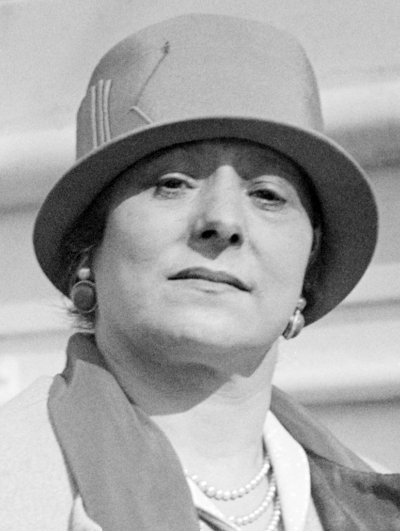
There is in fact a rivalry in the cosmetics world between two women at the head of thriving makeup companies. The Polish-born Helena Rubenstein, whose innovations in makeup include the idea of different people having different skin types, has a fierce competitor in Canadian-born Florence Nightingale Graham, founder of a company called Elizabeth Arden and promoter of the idea that makeup can be ladylike — to be worn by upper-class and middle-class women, not merely prostitutes. Both women opened salons in New York in 1915, and their companies have thrived since.
There are other makeup companies; mail-order businessman Thomas Lyle Williams developed a new mascara for his sister Mabel, which he accordingly named Maybelline. The flourishing of the motion picture industry, with its increasing use of close-ups, is helping drive makeup sales. But advertising is also increasing dramatically; the beauty industry spent $1.5 million in advertising in 1915, and will be spending ten times that in 1930. Note that the FDA won’t have the legal authority to inspect and regulate cosmetics until 1938, so use of makeup is not without risk (the 1938 law’s passed after one brand of mascara causes eye injuries to users, including a case of permanent blindness).
The first liquid nail polish didn’t appear until 1916 (colourless, with tinted polish introduced the next year); when bright red nail polish comes on the market in 1925 it’ll spark a craze, though the top and bottom of the nail will often be left unpainted (the “moon manicure”). In 1932 a new company called Revlon will introduce a liquid polish based on automobile paint; the first pigment-based liquid polish, it will be opaque, won’t streak, and will be available in a rainbow of colours.
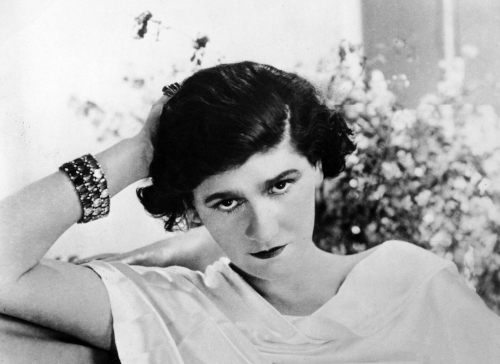
Women’s fashions are generally becoming simpler and standardisation more common; it’s also increasingly possible to buy cheaper knock-offs of haute-couture fashions. Note that fashion shows, hosted by large stores since at least 1910, have become spectacularly popular, and beauty salons are a growth industry — there were 750 in New York City in 1920, but by 1925 there’ll be 3000. It’s worth noting also that fashion designer Gabrielle “Coco” Chanel has her own store in France; her designs as much as any others have led fashion’s move away from corsets and toward simplicity, and in 1926 she’ll introduce the ‘Little Black Dress,’ hailed by Vogue as the “Ford of fashion” for its versatility and appeal. In 1922, she moved into perfume with the scent she called Chanel No. 5. In 1924 she’ll redesign the bottle, and the perfume will become a massive success. In 1923, she’ll accidentally get sunburned while on a trip to the French Riviera, and create the modern fascination with suntanning — birthing a new look, and reversing the traditional association between paleness and high status.
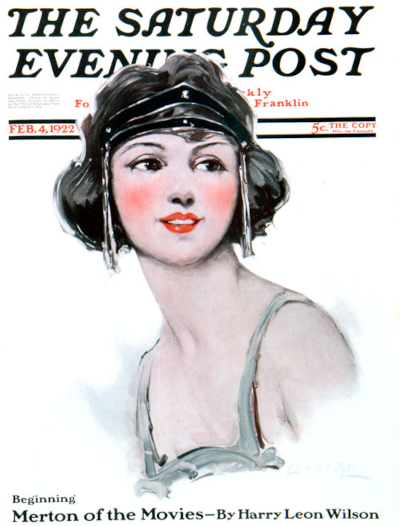
To return to women’s fashion: accessories at this time include headbands and clips, sometimes boasting feathers. And the discovery of sequins in Tutankhamun’s tomb has started a vogue for the things, at this time available only in the form of small metal plates. Another craze has recently started for cloche hats — bell-shaped hats worn low on the forehead. They’ve become popular because they complement short bobbed hair, newly in fashion. Along with short skirts, these things have become signifiers of a new figure of the 1920s: the flapper. The word had been around as slang for a young woman (and sometimes specifically for a prostitute) for some time, but by May of 1920, when a movie called The Flapper was released, it had come to refer to a specific subculture.
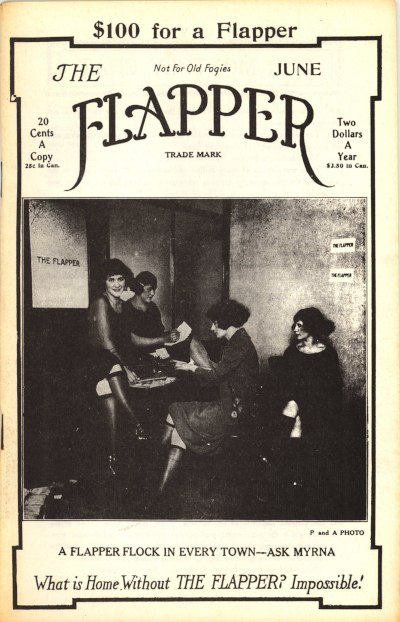
Flappers are perceived as independent, sardonic, flirtatious, and even hedonistic. Some of them publish their own magazine; and there’s at least one comic strip starring a flapper, Fritzi Ritz, begun October 9, 1922, by Larry Whittington (in 1925 it’ll be taken over by Whittington’s 20-year-old assistant Ernie Bushmiller, who’ll give Fritzi a young round-headed niece in 1933, and then in 1938 rename the strip after the niece: Nancy). Flappers have picked up on a new kind of dance, too, which in October will get a name from a song in a Broadway show called Runnin’ Wild — “The Charleston.”
Unsurprisingly, given the times, flappers are drawing criticism for their taboo-busting ways; in 1922 the Secretary of Labor complained about the “flippancy of the cigarette smoking, cocktail-drinking flapper,” calling their lifestyle “disturbing.” (Note that in 1923, only 5% of cigarettes smoked in the United States are smoked by women; but then again, as recently as 1904 a woman was arrested on New York City’s Fifth Avenue for smoking, and at least some railroad companies prohibit women smoking in dining cars.) In August of 1923, the PTA of a small town in Pennsylvania will try to establish an old-fashioned dress code at the local high school; a contingent of flappers will break into the meeting chanting “I can show my shoulders, / I can show my knees, / I’m a free-born American, / And can show what I please.” And yet no less an authority than Zelda Fitzgerald wrote a eulogy for the flapper in 1922, stating in part:
The Flapper awoke from her lethargy of sub-deb-ism, bobbed her hair, put on her choicest pair of earrings and a great deal of audacity and rouge and went into the battle. She flirted because it was fun to flirt and wore a one-piece bathing suit because she had a good figure, she covered her face with powder and paint because she didn’t need it and she refused to be bored chiefly because she wasn’t boring. She was conscious that the things she did were the things she had always wanted to do. Mothers disapproved of their sons taking the Flapper to dances, to teas, to swim and most of all to heart. She had mostly masculine friends, but youth does not need friends—it needs only crowds, and the more masculine the crowds the more crowded for the Flapper.
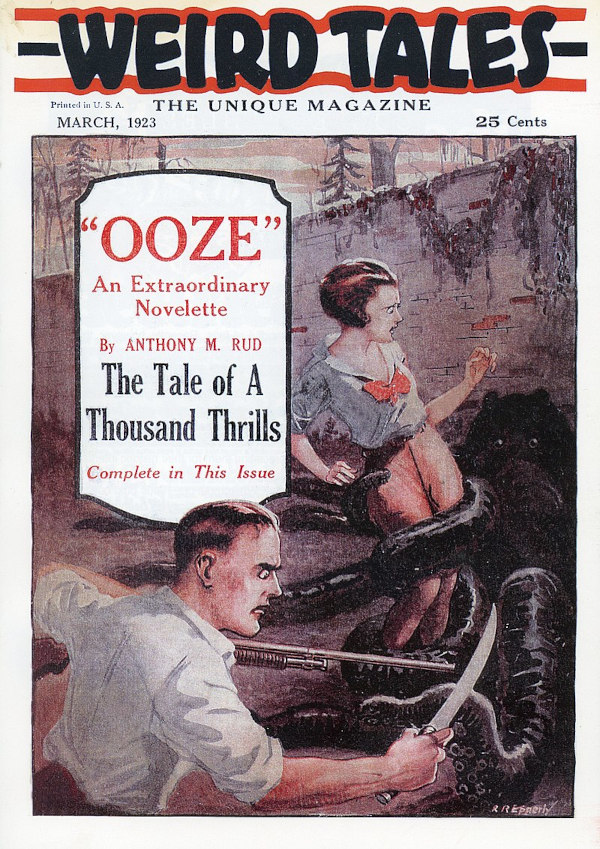
The flapper will become one of the lasting images of the 1920s, fitting the mood of the times, and, it has to be said, the perception of a new sexual permissiveness (more on this in a future post). As an archetype, the flapper can be seen in different manifestations in the films of the era — from Colleen Moore (relatively demure), to Clara Bow (the original “It Girl,” still basically good-hearted), to, a little later, Louise Brooks (maybe not mad, but certainly bad, and probably dangerous to know). If these icons seem far from Weird Tales, take a another look at the first issue; the young lady on the cover has bobbed hair. This doesn’t mean that she’s some sort of Eldritch Flapper (necessarily). But the magazine reflects its time, in small ways as well as great.
Find all my posts about Weird Tales here!
Matthew David Surridge is the author of “The Word of Azrael,” from Black Gate 14. You can buy collections of his essays on fantasy novels here and here. His Patreon, hosting a short fiction project based around the lore within a Victorian Book of Days, is here. You can find him on Facebook, or follow his Bluesky account, @bookofdays.
Ended up getting a whole education on suspenders/braces through the links on this article. H- and X-braces need to be more widespread than they are, now, given that men come in a variety of shapes, and not all of those shapes can find the prevalent Y-braces comfortable. And the idea of belt-and-braces to ease back strain for police officers was interesting to learn about, too, though I wonder how that really plays out with the protective vests shifting weight carriage up the torso. Women get back strain all the time with higher disposition of weight, even when supported on the shoulders.
“Hatless, but unconscious of it” is an interesting line. Lois McMaster Bujold’s Miles Vorkosigan tends to agree with that story’s author the essentiality of hats, if I recall correctly, because when confronted with the question of what piece of clothing he most wanted when he couldn’t have any, he chose a hat for its utility in expression, its moxie, and its imaginability. Bujold had him describe particular traits in his hat, but personally, I always imagined it as a jaunty, wide-brimmed fedora. Like a Mallory classic by Stetson.
Never heard of the “moon manicure” before, but it sounds like a precursor to the French manicure, in that it emphasizes the different color zones of the nail. Hmm. Have to say, though, the most surprising women’s fashion trend in this article was the bit about the rolled stockings and rouged knees. Cue double-take and “what?” And emphasizing the roll in the stocking top? I guess… maybe it’s equivalent to teens who deliberately wear contrasting bras under their spaghetti-strap tanks and dust their shoulders and decolletage with body-glitter…? Rolled stocking tops don’t seem to be very popular in depiction of the time period in fiction, either, from what I’ve seen. Not modern depictions, anyway. I don’t recall seeing them in “Moulin Rouge” (admittedly, I hate that movie, so may not have paid attention) or in “Miss Fisher’s Murder Mysteries,” and when the ghostly detective in the Alice Kimberly/Cleo Coyle Haunted Bookshop mysteries dream-walks the main character back in time to take a look at his cases, she usually has some sort of wardrobe malfunction involving twisted garter belt straps. Rolled stocking tops… weird. I remember sometimes schoolgirls in England rolled their uniform socks to their ankles, during the ’90s, but that was a practical thing because they lost elastic and fell down for most of the year.
Rolled stockings may end up being something I start watching for, to see who depicts Flappers correctly, and who doesn’t
Putting these background posts together is extremely educational for me, and one of the things I learned from this post is the many ramifications fashion has on health and kinesthetics and so forth — didn’t necessarily make it into the post, directly, but it’s something to think about. As you say, people come in different shapes, and one wonders why we don’t see depictions of varieties of garments.
When I read “Hatless, but unconscious of it” aloud to my girlfriend, she pointed out that it was a great example of efficient if unintentional worldbuilding. It tells you something about the society and its expectations and how men are expected to look. Which I thought was an interesting point. (The only Vorkosigan I’ve read is the first-published book, though I’ve heard great things about the series and how many different things it does.)
Your description of the ‘moon manicure’ sounds about right. Rolled stockings were surprising, I agree, having not thought about it; but now I’m not sure whether I’ve seen pictures of the style without really noticing it. Here’s a site with some discussion and photos of rolled stockings and made-up knees; and it basically agrees with your comparison to modern fashions: “Painted or rouged knees were flappers’ version of thong straps above low-rise jeans.”
https://vintagenewsdaily.com/hand-painted-knees-1920s-trend-you-probably-never-heard-of/
Urg, not “Moulin Rouge.” “Chicago.” That was the movie I meant. Dislike both, but only the latter was of the time period.
Your girlfriend is absolutely correct. It’s the sort of world-building that everyone strives for, but most often happens by accident. (Vorkosigan is worth reading through at least once. I forget which book had the hat incident, though.)
WOW. That is a heck of a way to draw attention to knees! Thank you for the link. I wonder how many of today’s tattoo artists would be knee-painters, if this was still a thing.
It’s the short story “Borders of Infinity” in the collection of the same name, when Miles is in the Cetagandan prison camp.
“Eldritch Flapper” was one of my favorite college bands.
Ah, yes, known for such hits as “Elder God River,” “St. John Blues,” and “It Had to be Cthulhu.” Honestly, their whole album “Rhapsody in the Colour Out of Space” was peak terror-jazz.
Their stars are no longer right, these days. I heard they were opening up for Boba Fetish at the armory this weekend.
Due to a remarkable coincidence, I happened to run across another 1920s fashion rule: cigarette holder length. Opera, dinner, cocktail, luncheon–and don’t bring the wrong length to the wrong event!
Another fantastic piece. I learned a lot of stuff I never knew about the evolution of fashion.
I should note that a fedora and a trilby are different styles of hats — mainly, the fedora has a wider and softer brim.
But the more interesting thing about fedoras and trilbies is that both hats were named after female characters! Indeed, female title characters. Indeed, the title characters of plays!!
The fedora was named for the title character of the 1882 play Fédora, by Victorien Sadou. The great actress Sarah Bernhardt played her in an 1889 production of the play and wore a fedora, though it wasn’t actually called that until about 1891. It was first a hat for women, but after the N/a/z/i Prince of Wales Edward (later briefly Edward VIII, then the Duke of Windsor) began wearing one in 1924, it became popular for men.
The trilby was named for the title character of the 1894 novel Trilby, by George du Maurier. (George du Maurier was Daphne’s grandfather.) Trilby is a young woman hypnotized by an evil man named Svengali to be a great singer. The hat derives from the hat that the actress playing Trilby wore in some productions of the very popular 1895 stage adaptation of the novel. (Note that two words were coined after characters from the novel and play: “svengali” of course is used for a manipulative older person who controls a younger person do do the older person’s bidding.)
As for Clara Bow, I happened to see part of one of her last films, Call Her Savage. I could see why she was an “It” girl — she really was beautiful. Alas, she had a terribly sad life by the end.
And, speaking of women smoking, I am reading a novel now, The House in Paris, by Elizabeth Bowen. It is set in about 1924 and also 1934, and the women do seem to smoke without fear of criticism. (This is in England and France, and the characters are upper class but not aristocratic. The novel was published in 1935.)
Rich, if I’m managing to write something that you actually did not know, then I have to believe I’m doing something right!
Thank you for the note on the distinction between trilbys and fedoras; I’ve made an edit. I knew about the origin of the trilby, though I haven’t read the play. I did not know about the fedora! I saw Clara Bow in *Wings*, and I thought she did a good job.
I have a vague idea that people taking up smoking oddly mirrors the way people (as a society) stopped smoking. From what I’ve read, while it had been around for awhile the habit grew by leaps and bounds in the late nineteenth century, and nobody really noticed to talk about it, and then suddenly everybody was doing it and it seemed normal and etiquette codes and so forth changed to match. Decades later, in the late 1990s or thereabouts, a few laws were passed, people stopped smoking, and the more people stopped the less need there was for smoking spaces, meaning there was more incentive to quit, and suddenly nobody smoked and it was so weird that only a few years ago you could smoke in restaurants.