Browsed by
Category: Reviews

Ad Review: The Dragon Magazine 41, Part I

Ad Review: The Dragon Magazine 41, Part I

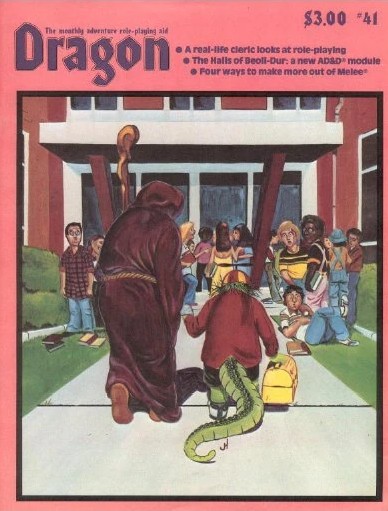
The Dragon, Issue 41, cover by James Holloway

In  August of 1980, I wandered into Klipper’s, my local toy shop that had a counter devoted to Dungeons and Dragons and other role playing games, and picked up a copy of The Dragon, issue 41. It was the first issue I purchased. On the cover, by James Holloway, a man in a wizard’s robe carrying a staff was walking a lizard child carrying a lunchbox to school, while the human students were starting wide-eyed.

At the time, I was most interested in the parts of the magazine that could most directly be added to my game. Dragon’s Bestiary, introducing the silkie and tomb tapper, the Giants of the Earth, which not only gave me heroes I could use, but introduced me to fantasy novels to track down, the Bazaar of the Bizarre. I remember incorporating the idea of dragon’s blood advanced by Robert Plamondon into my campaign. I ran my players through The Halls of Beoll-Dur, and enjoyed the exploits of Finieous Fingers.

Other parts were of lesser interest. I was not playing Metagaming’s Melee, which seven pages and four articles were devoted to. Similarly, the Avalon Hill articles by John Prados and Tom Wham were not things I was looking for at that time. Since I didn’t have a TRS-80, the computer program offered by Mark Herro didn’t offer me anything. The article on Napoleonic guerilla warfare was targeted at wargamers, not RPGers.

Revisiting this issue 46 years later, I’m looking at a different aspect entirely.  I found myself wondering “What was advertised in that issue of The Dragon and did any of the advertisers make enough of a splash to still be around after all this time?”

Read More Read More

Samurai Noir Meets Boardroom Politicking: The Last Contract of Isako by Fonda Lee

Samurai Noir Meets Boardroom Politicking: The Last Contract of Isako by Fonda Lee

The Last Contract of Isako, by Fonda Lee (Orbit, May 5, 2026). Cover by Thomas Walker

I spent my professional working life as a freelancer, temporarily employed by a various corporations, ad and media companies, start-ups, and consultants on a project, on-call, or contractual for a stated number of months basis. Work might last a month or two, sometimes as much as a year, and then I never hear from the employer again; others develop into long-term relationships, albeit at time with gaps (sometimes long gaps) between assignments.

As a “disposable asset,” I cost the organization less (even as I earn higher pay because there is no overhead expense) and am easier to terminate than a salaried employee. While in today’s gig economy job-seekers often have little choice but to settle for contract work, I turned down offers of full-time permanent employment (though “permanent” is a misnomer given the trend of corporate “restructurings” and “force redeployments” and other such euphemisms to disguise layoffs).

Read More Read More

Richard Stark’s Parker, Part 7: The Outfit

Richard Stark’s Parker, Part 7: The Outfit


The third Parker novel: The Outfit (Pocket Books, 1967)

What is it?

Volume 3 of Richard Stark’s Parker series of crime novels. It is also the third part of the unofficial Outfit Trilogy, the first three books in the series, in which Parker goes up against an organized crime syndicate.

Quick and Dirty Summary

After surviving an assassination attempt by a killer hired by the Outfit, Parker decides it’s time to settle matters with organized crime once and for all.

Read More Read More

Mary Poppins by PL Travers

Mary Poppins by PL Travers

Version 1.0.0

Mary Poppins gave a superior sniff.

“Don’t you know,” she said pitingly, “that everybody’s got a Fairyland of their own?”

Ultimately, I have Baird Searles (or you have to blame) to thank for pointing to P.L. Travers‘ original Mary Poppins books. To quote the entry in his A Reader’s Guide to Fantasy (1982),

Those who know P.L. TRAVER’s acerbic creation, Mary Poppins, only through the persona of Julie Andrews, do not really know Mary Poppins, despite the best efforts of that charming actress. Mary Poppins seldom has a kind word for anyone, almost never smiles except at heir own prim reflections, and can get four children washed and in bed with No Nonsense Whatsoever.

I didn’t rush out and buy the books, but his words always lingered in my memory, and when I saw the books for sale in the old Borders in the World Trade Center, I bought the first one, Mary Poppins (1934), and promptly devoured it. Strains of the book and its sequels can be heard in the Julie Andrews’ movie, but there are deeper, more mythic moments that I imagine Walt Disney wanted no part of.

Travers was born Helen Lyndon Goff in Australia in 1899. She took to the stage as a teenager, creating for herself the stage name Pamela Lyndon Travers. For several years she traveled in Australia and New Zealand as part of a Shakespearean company. In New Zealand, she became a published poet and later a primary writer for the women’s sections in a Christchurch newspaper.

Read More Read More

Spoiler Free Review: Coyote vs. Acme

Spoiler Free Review: Coyote vs. Acme

Coyote vs Acme

In the early 1990s during grad school, I stood outside Professor Derek Penslar’s office, waiting to talk about a class I was taking with him. He had a variety of cartoons and articles posted on his door. Two that I remember were an efficiency consultant’s report on Schubert’s Unfinished Symphony and Ian Frazier’s New Yorker article “Coyote v. Acme.” I picked up a copy of Frazier’s collection titled after that piece when it became available.

Tonight, my wife, a friend, and I got to see the movie inspired by that Frazier article: Coyote vs. Acme. We almost didn’t get to see it.

Filmed in spring of 2022, Warner Bros. Discovery announced plans to shelve the film in November 2023 in order to take a tax write-off, much as they did with Batgirl and Scoob! Holiday Haunt. After a private showing of the film for the cast and crew, however, Warner Bros. Discovery allowed the filmmakers to seek another distribution deal, partly because of public backlash to the decision caused by comments made by the filmmakers. In March of 2025, Ketchup Entertainment bought the distribution rights, screening it first at San Diego Comic-Con and then releasing it on August 28, 2026.

Read More Read More

Almost Gothic: The Nine Tailors by Dorothy Sayers

Almost Gothic: The Nine Tailors by Dorothy Sayers

The Nine Tailors, first edition (Harcourt, Brace, 1934)

The Nine Tailors has been described as the best of Dorothy Sayers’s novels. It certainly has many of the features of classic literary fiction, including a small rural community as a setting; a cast of characters from every level of society; and elaborate symbolism focused on a set of church bells, each with a meaningful name. Indeed the entire novel seems to have a symbolic level of meaning over and above the literal plot of the mystery. Of course mystery novels nearly all begin in medias res, with the discovery of a death, after which the detective reconstructs the previous events; but this novel’s backstory reaches back roughly two decades, to the Great War, and includes much more than the death.

The title The Nine Tailors alludes to the old saying “Nine tailors make a man.” This is sometimes taken as a slur on tailors as cowards or weaklings, saying that one real man is worth nine of them; but Sayers has in mind a custom of ringing nine strokes of a church bell for a man’s death, six for a woman’s, or three for a child’s. There are several deaths in the course of the novel.

Read More Read More

Richard Stark’s Parker, Part 6: The Man with the Getaway Face

Richard Stark’s Parker, Part 6: The Man with the Getaway Face


The second Parker novel: The Man With the Getaway Face (Pocket Books, 1963)

What is it?

Parker has gone to a lot of trouble and expense to get a new face. Now he has to fight to keep his identity hidden, while also planning and executing an armored car heist.

A treacherous waitress and a punch-drunk former boxer complicate those matters tremendously.

This is Volume 2 of Richard Stark’s “Parker” series of crime novels. It is also the second part of the unofficial Outfit Trilogy, the first three books in the series, in which Parker goes up against an organized crime syndicate.

Read More Read More

Sour Bill: The Issue at Hand and More Issues at Hand by William Atheling, Jr.

Sour Bill: The Issue at Hand and More Issues at Hand by William Atheling, Jr.

The Issue at Hand, by William Atheling, Jr., AKA James Blish (Advent: Publishers, 1964). Cover by Jon Stopa

In 1952, a science fiction fanzine, Sky Hook, began publishing a series of critical essays by William Atheling, Jr. When its publisher, Redd Boggs, suspended publication, the science fiction writer James Blish publicly revealed that this was a pseudonym he had adopted. But a few years later, he revived “Atheling” for more criticism, published in another fanzine, Axe.

In 1964, Advent: Publishers collected his critical writings, including both fanzine articles and addresses given at science fiction conventions under his own name, as The Issue at Hand, credited to Atheling, “edited and with an introduction by James Blish,” though the book made no secret of the author’s identity. In 1970, a second collection appeared, More Issues at Hand.

Read More Read More

David C. Smith, Part 5: Sometime Lofty Towers, A Magnificent Work of Sword & Sorcery

David C. Smith, Part 5: Sometime Lofty Towers, A Magnificent Work of Sword & Sorcery


Sometime Lofty Towers (Brackenbury Books, December 2025). Cover by Saša Đurđević

I’ve just finished reading what may be David C. Smith’s best work — Sometime Lofty Towers.

My first contact with Smith was from the Robert E. Howard related pastiche work he did earlier in his career. He wrote an excellent Black Vulmea story, The Witch of the Indies (Zebra, 1977, cover by Stephen Fabian), and a Bran Mak Morn tale, Witch of the Mists with Richard Tierney (Zebra, 1978, cover by Doug Beekman), and he and Tierney (1936 –2022) collaborated on six novels about Red Sonja. The Sonja tales are not REH pastiches, of course, but are based on a comic book character created to interact with Conan in the Marvel series.

Read More Read More

Richard Stark’s Parker, Part 5: Payback

Richard Stark’s Parker, Part 5: Payback

Payback: Straight Up Director’s Cut (Paramount direct-to-home-video, 2006)

Payback: Theatrical Cut and Straight Up (The Director’s Cut)

1999 theatrical release; recut, direct-to-home-video DVD in 2006. Written by Brian Helgeland (with Terry Hayes) and directed by Brian Helgeland (with Paul Abascal).

What is it?

Brian Helgeland (A Knight’s Tale; Man on Fire; the script for LA Confidential) wrote and directed this adaptation of The Hunter, the first novel in the Parker series, starring Mel Gibson.

As the film was nearing completion, test audiences reportedly reacted poorly to the ending. And yeah, it’s pretty dark and violent and certainly not the triumphant conclusion many Gibson fans were probably expecting. Consequently, Gibson and the studio removed Helgeland from the film. They brought in Terry Hayes to rewrite the ending and added Kris Kristofferson as a new “final boss” villain.

Read More Read More