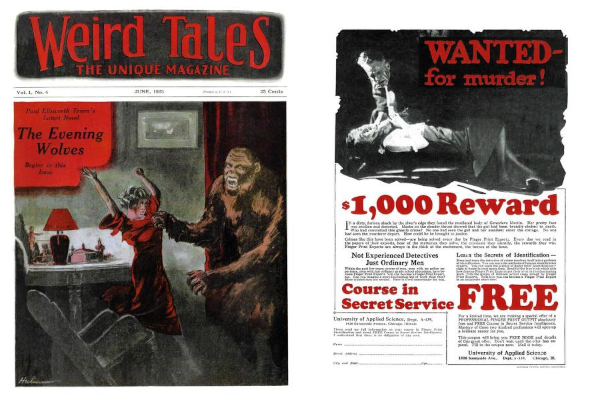
Weird Tales, June 1923, front and back coversThe fourth issue of Weird Tales, dated June 1923, keeps the same format as the issue previous — starting with the large bedsheet size, about 9 inches by 12. The trade dress of the cover is the same, with the same logo. The design of the cover, with a splash of red in which one story is advertised in black writing, is the same. Unfortunately, the actual cover art, by regular Weird Tales artist William Heitman, isn’t very good.
There’s a lady, there’s an ape, and the latter seems to have surprised the former in her room. The majority of Weird Tales readers were likely able to place the image at once as a scene from Edgar Allan Poe’s “The Murders In the Rue Morgue,” which is reprinted this issue. The problem is that it’s not a particularly evocative image, and the poses of the characters seem odd at first glance and make less sense the more you look at them.
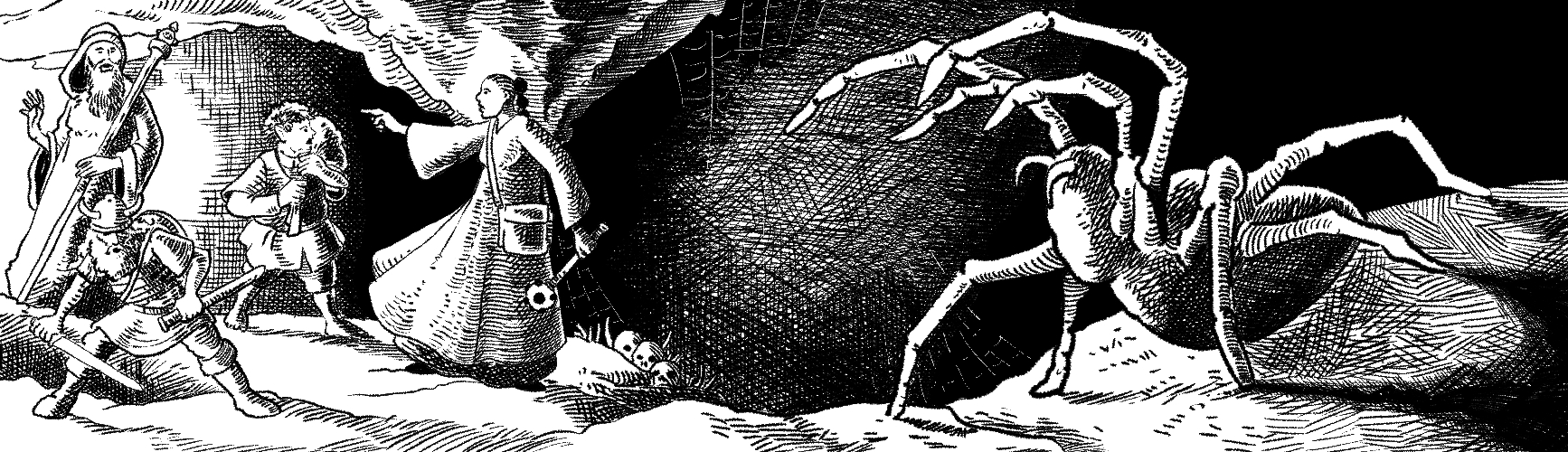
Miguel Santos’ Banner Art for #69. A tip of the hat to a classic!
Happy news, S&S fans! Heroic Fantasy Quarterly #69 is out and it is one of our most ambitious issues yet.
We’ve got four stories and three poems, three audio works, the next two pages of Miguel Santos’ comic Ancestors and more art than you can shake a broadsword at!
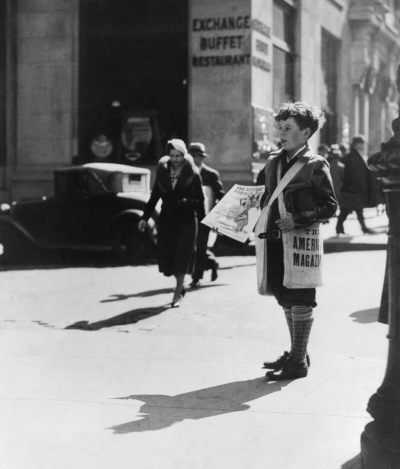
A newsboy in the 1920s.
This is the sixth post in a series reflecting on the world of the 1920s as a background to early issues of Weird Tales. Imagine that you’re an American in a big city in 1923, and you’re taking a walk to the newsstand to buy the first issue of a new pulp fiction magazine. What sort of things might you see? What do those things suggest about ways people think? What do they say about the stories they tell?
And what might you hear? Cars, of course, and maybe the buzz of conversation around you. But perhaps you’ll hear the voice of a boy on a streetcorner, holding up a newspaper and crying out a still-famous phrase: Extra! Extra! Read all about it! For this is a time when newsboys are still a feature of urban life.
The new format Weird Tales adopted for its third issue reached right into the table of contents, which dropped from two pages to one, with of necessity a more cramped layout. One extremely short story isn’t listed, but the magazine makes sure to promote “Nineteen Thrilling Short Stories” along with “Two Complete Novelettes.” That’s actually an increase over the last issue, which had sixteen short stories and two novelettes. So, having discussed the format in a previous post, let’s now look closely at this issue’s fiction.
And it is necessary with this issue to talk about race in Weird Tales, starting with the first story in the magazine (so this post will include quotations and mentions of period racism). “The Moon Terror,” by A.G. Birch, is promoted by a cover blurb; it’s 30,000 words long, 20,000 of which appear in this issue, with the conclusion in the next month’s magazine. It’s a textbook example of Yellow Peril racism, in which sinister East Asians menace white people and the Western world. In this case, the villains are a secret Chinese society who threaten the planet as a whole with increasingly powerful earthquakes.
Last week, I began looking at the ads from issue 41 of The Dragon magazine. This week I take a look at the ads I didn’t get to last week.
After looking at the in house ads places by TSR, ads for local gaming stories, miniatures, and a variety of accessories, it seems like a good time to turn my attention to some of the games being offered in the issue. I’ll start, not with table top or board games, but rather play-by-mail games, which I attempted to play once, but could never really figure out how to interact with them. For me, they were more an intriguing concept than a recreational outlet. I may not have been alone in that. I only see four other articles on Black Gate that even mention play-by-mail games.
Two play-by-mail games were advertised in the issue. The first, World Campaigns IV was a military campaign set following World War III as the players attempt to rebuild civilization. Rather than a massive player game, players set up in groups of 35 (and if you sent in your application with friends would be grouped together). The rules and first move cost $8, with subsequent moves costing $5 and a maximum of 8 moves per year. World Campaigns IV was based out of Dover, New Hampshire. Playtesting for the game began in 1977 with the game launching in 1980. In 1988 the game relaunched as World Campaigns V, which allowed for longer games. A computer moderated version was also launched in 1988.
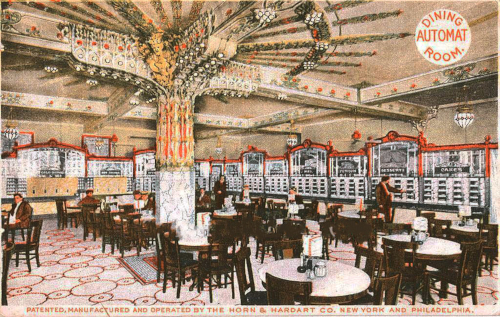
A postcard showing an early-20th century Horne & Hardart automatThis is the fifth post in a series reflecting on the world of the 1920s as a background for discussing the early issues of Weird Tales. Imagine that you’re an American in a big city in 1923, and you’re taking a walk to the newsstand to buy the first issue of a new pulp fiction magazine. What sort of things might you see? What do those things suggest about ways people think? What do they say about the stories they tell?
Let’s say you get hungry as you walk along, and think about getting some food later. Maybe you see a restaurant, and a grocery store near it. What kind of food will you be able to buy in the store? And what sort of a restaurant are you looking at? There are a lot of potential answers to that second question, but I want to focus on one admittedly unusual possibility. If you’re in the right city, especially New York or Philadelphia, maybe you have the chance to pop into an automat. And in New York, you might even spot a future Weird Tales writer drinking the hot chocolate.
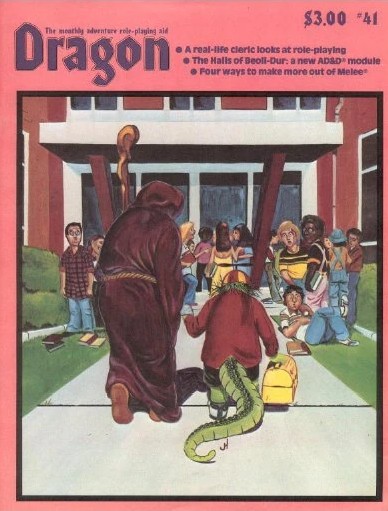
In August of 1980, I wandered into Klipper’s, my local toy shop that had a counter devoted to Dungeons and Dragons and other role playing games, and picked up a copy of The Dragon, issue 41. It was the first issue I purchased. On the cover, by James Holloway, a man in a wizard’s robe carrying a staff was walking a lizard child carrying a lunchbox to school, while the human students were starting wide-eyed.
At the time, I was most interested in the parts of the magazine that could most directly be added to my game. Dragon’s Bestiary, introducing the silkie and tomb tapper, the Giants of the Earth, which not only gave me heroes I could use, but introduced me to fantasy novels to track down, the Bazaar of the Bizarre. I remember incorporating the idea of dragon’s blood advanced by Robert Plamondon into my campaign. I ran my players through The Halls of Beoll-Dur, and enjoyed the exploits of Finieous Fingers.
Other parts were of lesser interest. I was not playing Metagaming’s Melee, which seven pages and four articles were devoted to. Similarly, the Avalon Hill articles by John Prados and Tom Wham were not things I was looking for at that time. Since I didn’t have a TRS-80, the computer program offered by Mark Herro didn’t offer me anything. The article on Napoleonic guerilla warfare was targeted at wargamers, not RPGers.
Revisiting this issue 46 years later, I’m looking at a different aspect entirely. I found myself wondering “What was advertised in that issue of The Dragon and did any of the advertisers make enough of a splash to still be around after all this time?”
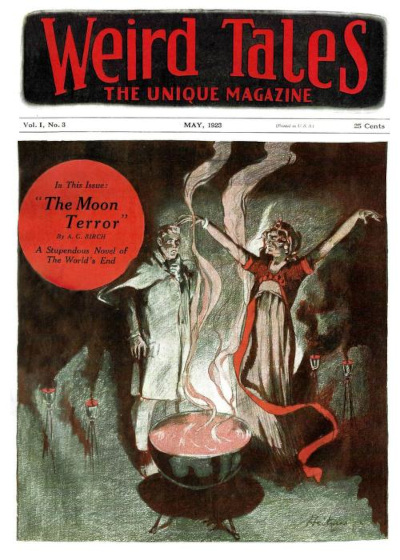
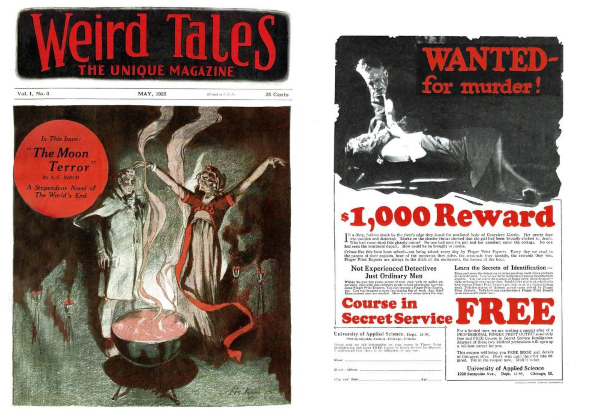
Weird Tales, May 1923, front and back coversThe third issue of Weird Tales saw the magazine experiment with a significant change in presentation. The first two issues had been a standard pulp size, about 6 inches by 9; the May 1923 issue went to the bedsheet format, a bit more than 9 inches by 12, while cutting the number of pages from 192 to 120. Open the issue, or look through a pdf file, and further changes become apparent.
The layout’s gone to three columns of text instead of two. There are two reprints in the issue, one of them printed at a reduced type size, presumably to fit the space available. And the magazine boasts interior artwork for the first time, with nine stories getting uncredited illustrations; black-and-white line drawings, usually with heavy hatching and cross-hatching.
The artist was presumably this issue’s cover artist, William Heitman, who seems to have done all the interior artwork in Weird Tales’ first year. Heitman’s two-colour cover image is simple, bordering on crude, but conveys a mood. The blurb on the cover is for A. G. Birch’s “The Moon Terror,” though there’s nothing in the story like the picture, for reasons which we’ll come to later on in this post. The colour scheme of the cover’s similar to the last issue, with solid red and black, but the logo’s the third in three issues — though the magazine’s subhead, “The Unique Magazine,” has remained consistent.
The flag of the United States of America, with 48 stars at top and with 50 at bottom.
This post is the fourth in a series reflecting on the world of 1923, and the 1920s generally, as a background to early issues of Weird Tales. Imagine that you’re an American in 1923, and you’re taking a walk to the newsstand to buy the first issue of a new pulp fiction magazine. What sort of things will you see?
You might, for example, see a flagpole with an American flag on it. It is a flag with a regular grid of stars in the corner, six rows of eight stars apiece, representing the 48 states of the Union. The United States in 1923 is a different place from what it will become a hundred years later, with a population that is distributed differently, different territories, a different self-image and different ideas about the nature of its peoples.
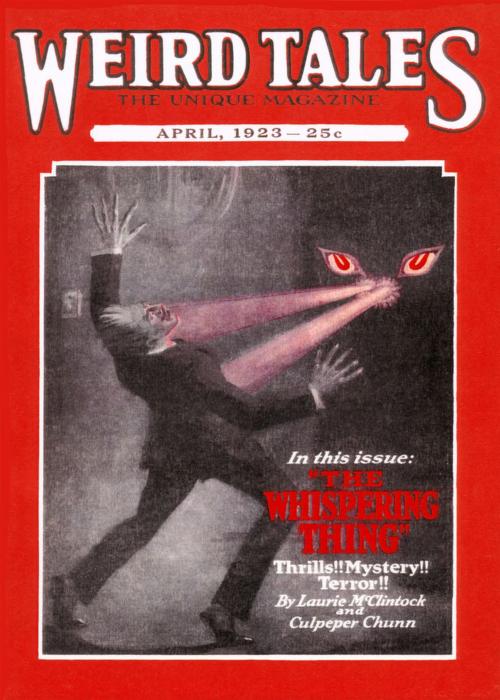
Weird Tales, April 1923
The table of contents of the second issue of Weird Tales advertises “Sixteen thrilling short stories / Two complete novelettes / Two two-part stories / Interesting, odd, and weird happenings.” More specifically, one of the two-part stories, the cover story, begins this month while the other concludes. As for the “interesting, odd, and weird happenings,” I wrote about them here, so now let’s get to the fiction. (Note that discussion of one of these stories necessitates quoting an ethnic slur, directed against the French, of all people.)
The first of the tales on offer in this issue is one of the novelettes, “The Scar,” by Carl Ramus (whose surname’s misspelled in the table of contents as ‘Rasmus’). It’s the only known published story by Ramus, though his sister Sybla was a writer whose work would later appear in Weird Tales. Carl Ramus had a day job as a doctor, and as it happens “The Scar” is a tale of a dashing young doctor pulled into a kidnapping plot. It’s not a terrible story, but it’s a surprising choice to lead off the issue as there’s little supernatural about it — the heroine claims to be able to bring on a fever by willing it and the hero believes he has a knack for hypnotism — and nothing I can see as ‘weird’ in any other sense. If the magazine’s still in the process of defining itself, then editor Edwin Baird has a different sense of where he intends it to go than we might expect from our later perspective.